12.11.2026 · 9 min read
We Stopped Competing on Product. That's Why We're All Losing.
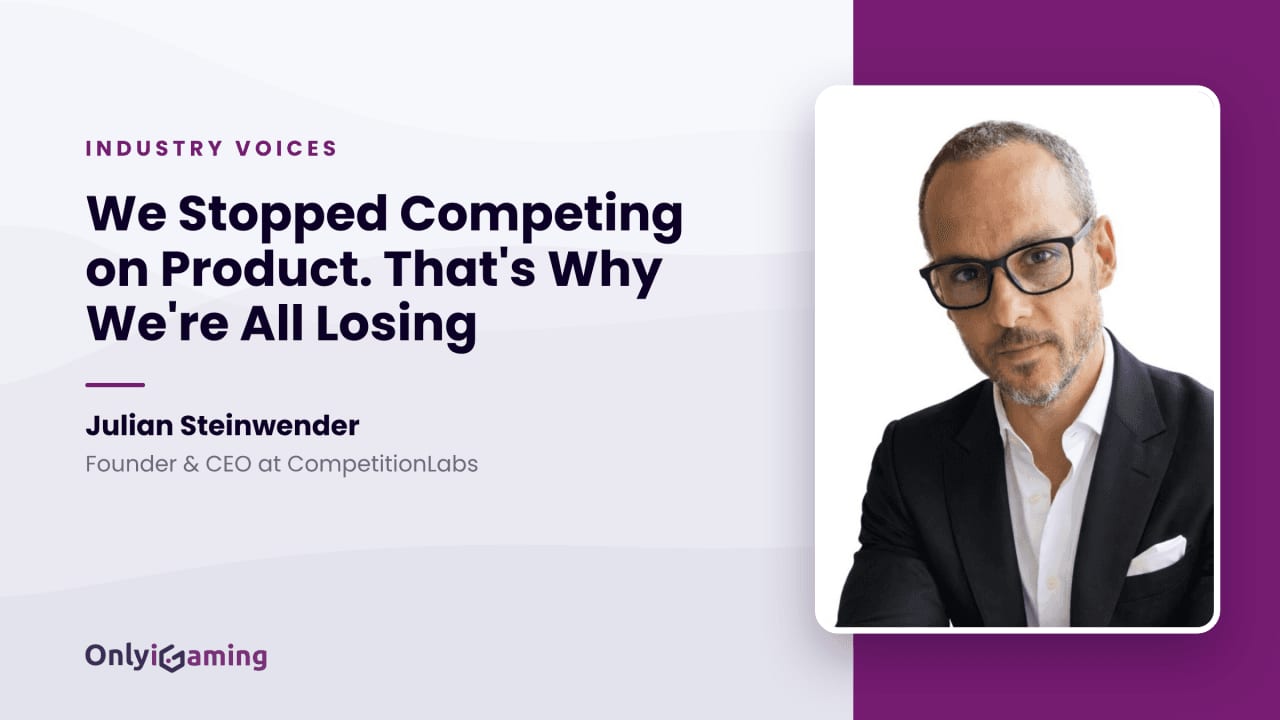
We Stopped Competing on Product. That’s Why We’re All Losing.
Ask anyone in this business to describe “the player” and they’ll describe the same person. Mid-thirties, sports fan, deposits on the weekend. I’ve worked around iGaming growth and product for years now and I’ve never met that person. Not once. What I’ve met is all sorts of people, behaving in all sorts of ways, and almost none of them fit the segments we still run our businesses on.
I think most of our retention problems start right there. We’re solving for a player who stopped existing a while ago.
Who do we even mean by “the player”?
Early in my career, segmentation was easy. Recreational players were A, VIPs were B. You knew who they were, how to talk to them, roughly what they were worth. Simple.
That world is gone. We killed it ourselves, honestly, and then never acknowledged it.
Look at who actually shows up now. Younger, mobile first, and raised on entertainment that has nothing to do with how our playbooks were written. The same person can be a casino regular on Tuesday, have a bet on Saturday’s match, and trade a position on some election or award show by Sunday night. Try fitting that into an A and B bucket. Our segments were always buckets, and our players have turned into fluids.
When I sit in a meeting and hear a team plan around a static recreational versus VIP split, I don’t hear strategy. I hear someone driving with an old map.
The attention war we quietly lost
Here’s what makes me uncomfortable. We used to compete against scheduled things. A match on TV, a big tournament, the weekend fixtures. You knew when the attention was available and you planned around it.
That’s over. Our real competition now is short video, streaming, doom scrolling. Anything in a pocket that delivers a hit at 11pm on a Tuesday. We’re not fighting each other for a fixed pool of attention anymore. We’re fighting everything.
And within gambling itself, the always-on bet has arrived. Prediction markets let people stake money on basically anything happening in the world, and that’s not a niche thing anymore. In the space of two months in 2026, monthly trading volume across the two biggest platforms went from $26 billion to $53 billion. Sports drove most of that and now sits at the top of the trading charts on both. Then there’s virtual sports, running around the clock with no fixture list at all.
So the player who waits for Saturday? Gone. The player filling a two-minute gap on the bus? Very much here.
And we’re still designing retention journeys around the weekly deposit cycle. I’ve sat in those planning meetings. They never end well.
Everyone sells the same casino, and everyone knows it
Do the exercise. Strip the logo off your platform and off your closest competitor’s. Could the average player tell them apart?
Same slots, pulled from the same handful of aggregators. Same live studios. Same welcome offer with a different colour scheme. Same tournaments. A huge and still growing global market, contested with near-identical product.
So what does differentiate? Follow the money and you get your answer: brand awareness and trust. And that’s rational, to be fair. When the product is like for like, the brand is all that’s left. In my experience trust has quietly become the real currency of a saturated market. Players can’t compare products, so they compare feelings.
Which brings me to the question I get asked most.
Can you grow without a huge brand investment?
Yes. But only if you accept that you’ll be playing a different game, not the same game badly.
First, be honest about what the shouting path costs. In every mature market the biggest operators outspend everyone else on TV, sponsorship and celebrity faces. That buys them something real, fame. But fame isn’t loyalty, and a challenger trying to match that spend is just renting irrelevance.
Second, be honest about the acquisition numbers. The figure on the performance dashboard always flatters the story, because it counts the deposit and forgets everything before it. Welcome offers, payment friction, compliance costs, whatever share of the marketing budget exists purely to keep pace with competitors. The true cost of a first-time depositor is always higher than the number on the screen. That gap is where growth campaigns quietly go to die.
Then look at the other path. Operators who invest in the experience around the product, onboarding, personalisation, missions, the small moments between bets, hold players longer than the market average. And lifetime value compounds with every extra month a player stays. Everyone with a mature CRM function already knows acquiring a new player costs several times more than keeping one. They see it in their own numbers every month.
Doubling retention without spending a cent on television is a strategy a mid-size operator can actually afford. Growing without the brand budget means refusing to play the game where shouting is the scoring system.
FTDs or repeat play: what actually moves the needle
I’ll be blunt, because this is the most under-used lever we have.
The FTD is the metric we celebrate. Repeat play is the metric that pays. Most first-time depositors are gone within days. A big share never come back at all. We pour money into the front door while the back door swings open, then we re-acquire our own lapsed players next quarter and report it as growth. I’ve watched teams do exactly that and call it a win. It’s a treadmill.
Do innovative mechanics actually move repeat play, then? I believe they do. The psychology has been understood for years. Break play into small goals with an end point. Make progress visible through points, levels, badges. Let people measure themselves against others, or chase something personal. You give the experience a shape that survives any single game result, and that shape is what brings someone back tomorrow. Operators who build it tend to see better retention, deeper engagement, and value that compounds over a player’s life.
One caveat, and it’s where I lose patience. A streak mechanic that exploits loss aversion against an at-risk player isn’t innovation. It’s harm with a progress bar attached. There’s a difference between gamification designed for a player’s experience and gamification designed against their willpower, and that difference is the whole game. Goals have to be attainable. Progress has to be visible. The reward has to feel worth it. Most implementations I’ve seen fail on all three counts.
FTDs get you a cohort. Mechanics get you a player base.
Slowing the drain, and whether we can act more responsibly
This is the question I care about most, because commercial sense and decency point the same way here.
There’s a cynical version of slowing the drain. Extract the same money more slowly, keep the player alive longer. Players feel that, by the way. And regulators are already looking for it. Then there’s the sincere version: maximise entertainment value per session instead of revenue per session. A player who has fun on a modest budget comes back next month, and the month after, for years. A player who emptied their wallet on Saturday doesn’t come back at all. You lose the human and the value in the same night.
The commercial case for the sincere version is simple. Players who feel safe and respected stay longer. The tools that create that feeling, deposit limits, reality checks, easy cooling-off, cost almost nothing to provide. And regulation is making it unavoidable anyway, with affordability and financial risk checks spreading across regulated markets. If you build genuinely safe experiences voluntarily, you shape them on your terms. If safety gets imposed on you, someone else shapes them. In my experience, compliance you choose is strategy. Compliance you’re handed is cost.
Here’s the part that should embarrass us. Across this industry we still spend far more on celebrity faces than on player protection, and then we wonder why public trust keeps sliding. Personalised safer gambling communication at scale is technically trivial now. The gap between what we could do and what we fund is the real scandal in this story.
Slowing the drain isn’t charity, either. It’s the same retention lever, pointed in the right direction. Entertainment-first design, honest mechanics, genuine safer gambling tools. They all push the same number: player lifespan. We treat them as three separate things. They’re one thing.
Has AI replaced the feel?
I want to be fair to both sides here, because the debate is real.
AI personalisation can read every signal now. Game choice, session rhythm, stake behaviour. It adjusts the experience in real time and it works. Players stay longer when the experience feels built for them. Fine. Accepted.
But AI tells you what a player does. It never tells you why. Someone who’s worked a VIP floor, answered a live chat at 2am, watched how a player reacts to their first big win, that person knows things a churn model will never surface. My view after watching this play out for a while now is simple. AI hasn’t replaced the feel. It’s exposed how few of us still have it. The setup that wins is AI doing the watching and humans doing the feeling. If your data team replaced your product instinct instead of sharpening it, you didn’t modernise. You outsourced taste.
So what is gamification, actually?
I ask this in meetings and I get answers from a decade ago. Leaderboards, a points balance, a birthday freebie. Come on. That’s decoration.
Real gamification gives play a purpose beyond the payout. Daily tasks and weekly challenges with a clear end point. Experience points that turn a one-off promotion into a longer journey. Badges that mark something. Tournaments with a social edge. Tiered programmes where status is trackable and milestones actually unlock. Personalised challenges built around how one person actually plays. Done properly, players come back because the experience itself pulls them, not just the money. That’s what differentiation looks like when the catalogue is identical for everyone. You can’t own the games. You can own the experience around them.
Where I land
If I were setting priorities at an operator today: redefine who the player is, because the static segments are fiction. Treat repeat play as the growth engine, because the FTD is the most expensive illusion we buy. Differentiate in the journey around the product, since the catalogue is a commodity and the experience isn’t. Pair AI with instinct. And slow the drain on purpose, because the player still having fun in twelve months is the only growth that compounds.
The early days rewarded whoever got online first. The last era rewarded whoever shouted loudest. The next one rewards whoever actually knows their player. Not the player we remember. The one on the app right now, deciding whether we’re worth two more minutes.
Spotted a mistake, or have a question about this article?
Categories
Enjoyed this story?
Add OnlyiGaming as a preferred source on Google to see more of our reporting.

Comments (0)
No comments yet. Be the first to share your thoughts!