19.10.2026 · 10 min read
Your CRM Cannot Answer the Question Finland Is About to Ask

Fourth in a series of six on marketing under the Finnish gambling licence. OnlyiGaming, Industry Voices. By Gloria Kesa, FinEst Verba.
From 1 July 2027, before any campaign goes to Finnish players, an operator must be able to pull one list from its database: every person who has played its games in the last 24 months. Anyone not on that list cannot be marketed to. In my experience, few operators have ever had to run that check.
What are the direct marketing rules under the Finnish Gambling Act (Rahapelilaki 10/2026)?
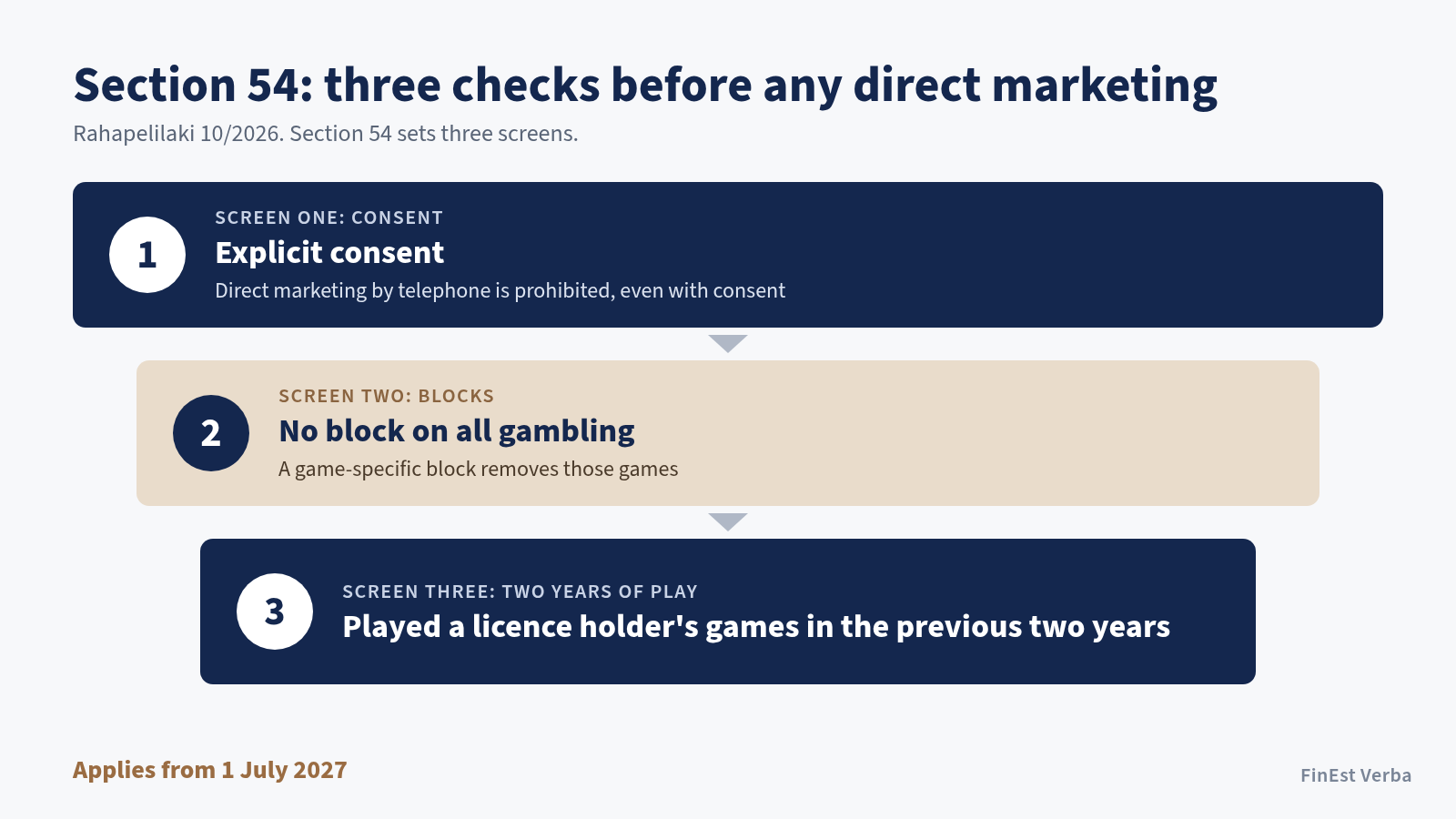
Section 54 sets three screens. Direct marketing needs the person's explicit consent, and telephone direct marketing is prohibited.
No marketing may target anyone with a block on all gambling, and a game-specific block removes those games.
The two-year rule: marketing may not be targeted at a person who has not played a licence holder's games during the previous two years (54(3)).
They apply from 1 July 2027, when the Act mainly comes into force, about eight and a half months from mid-October 2026.
My reasoning: Understanding the policy is the easy bit. Proving it is followed needs data, and that takes longer. In my reading of the coverage, the law-firm briefings give the rule a short paragraph at most, and none I have read deals with the play-history query.
The rule today: what it means for an applicant
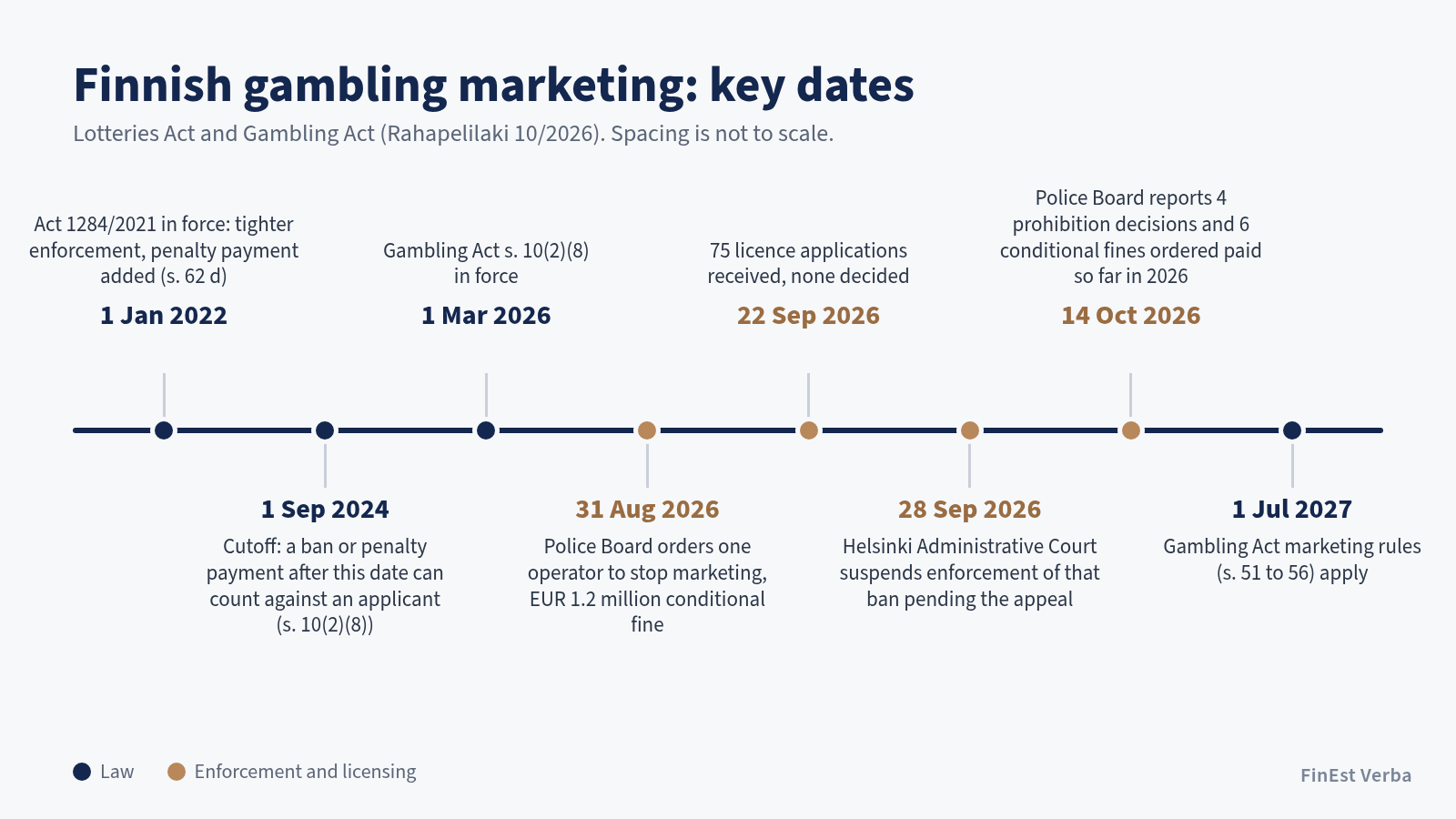
The Lotteries Act (Arpajaislaki 1047/2001, section 62) governs marketing until the Gambling Act's marketing rules, sections 51 to 56, apply on 1 July 2027. Under section 62(2)(1), marketing gambling games other than Veikkaus Oy's is prohibited.
According to the Ministry of the Interior, Veikkaus may market only the company and gambling games without a high risk of gambling-related harm. Act 1284/2021, in force from 1 January 2022, tightened enforcement and added the penalty payment in section 62 d.
On 14 October 2026 the National Police Board reported four prohibition decisions and six conditional fines ordered to be paid so far this year, for marketing on websites and social media. The conditional fines backing its bans ranged from EUR 100,000 to EUR 1.2 million for companies and EUR 30,000 to EUR 200,000 for individuals.
The six ordered to be paid were all against individuals, at EUR 20,000 to EUR 100,000. Its definition of marketing includes "all activities aimed at increasing demand for gambling games".
On 31 August 2026 the Board ordered one operator with four Finnish-facing brands to stop marketing gambling to Finnish consumers online and on social media, with a conditional fine of EUR 1.2 million, and on 28 September, after the operator appealed, the Helsinki Administrative Court suspended enforcement until it decides the appeal or orders otherwise. As of 18 October 2026, the ban had not taken effect and no later ruling had been reported.
Under section 10(2)(8) of the new Act, in force since 1 March 2026, an applicant cannot be considered reliable and suitable if, within the two years before the assessment and after 1 September 2024, it received a prohibition decision or a penalty payment for organising or marketing gambling in breach of the Lotteries Act.
My reading for CRM teams: a retention email, text message or bonus offer sent to a Finnish player today falls within the Board's definition. An applicant that sends it before holding a licence markets in breach of the Lotteries Act and could put its own application at risk. The decisions the Board has described concern websites and social media, so this is reasoning. Whether a decision under appeal counts under section 10(2)(8) is for counsel.
The Lotteries Act ban is not keeping unlicensed casino ads out of Finnish media. Rahapelisanomat reported on 16 October 2026 that Finnish-language Hype Kasino ads, offering for example a EUR 500 bonus, ran in October on the sites of Iltalehti, Helsingin Sanomat and Hufvudstadsbladet (Source https://rahapelisanomat.fi/).
Ads for Daler, Slottimonsteri and Bet Ninja were seen there too. Veikkaus is the only licensed operator until 30 June 2027.
Riikka-Maria Lemminki, CEO of Marketing Finland, told Rahapelisanomat: "Ads often end up in the media through programmatic buying." For Hufvudstadsbladet, Robin Andersson of Bonnier News said: "That Hype casino ad has now been blocked from our site."
My reasoning: a publisher can say an ad slipped through an automated system. A CRM team cannot, because the operator picks every name on the list.
The three screens, and what each costs
Translations from the Finnish are mine. Section 51(6) permits direct marketing "on the conditions laid down in section 54". Section 54 in full:
Direct marketing may be targeted only at a natural person who has given explicit consent to it.
Direct marketing by telephone is prohibited.
Marketing may not be targeted at a person who has set a block on all gambling for themselves, or who has not played an exclusive licence holder's or a gambling licence holder's games during the previous two years.
If a person has set a game-specific block, only marketing of a game whose play they have not blocked themselves may be targeted at them.
The Act does not define direct marketing. The government bill explains it, in this context, as marketing communication targeted directly at the recipient, for example by telephone, text message, email, post or a private message in social media (HE 16/2025, p. 328).
Screen one: consent. The bill says consent must not be hidden in unrelated terms, and being a customer must not automatically include it (p. 328). The telephone ban means calls, "as distinct from" text message marketing, and applies even with consent (p. 328). Text messages are therefore available with consent, subject to screens two and three. Nordic Law agrees they are permitted. My reasoning on cost: consent collected inside general terms has to be collected again, separately.
Screen two: blocks. No marketing to a person with a block on all gambling, and only unblocked games for a person with a game-specific block. My reasoning on cost: this is a suppression list, and it has to be current at the moment of sending.
Screen three: two years of play. My reasoning on cost: this is the expensive one. A flag cannot answer it. It needs an event history. A list not screened against that window fails, however careful the message is.
On scope. Subsections 1 and 2 say "Suoramarkkinointia", direct marketing. Subsections 3 and 4 say "Markkinointia", marketing. The bill says the targeting ban for blocked players covers all targeted advertising, including targeted display advertising where cookie data shows a block (p. 328). The two-year limb sits in the same sentence.
My reading: it reaches any marketing targeted at a person. Nordic Law describes both limbs as direct marketing rules. Counsel should settle the scope.
Whose games: the own-games reading
The Finnish is "ei ole pelannut yksinoikeustoimiluvanhaltijan tai rahapelitoimiluvanhaltijan pelejä edellisen kahden vuoden aikana". Finnish has no articles, so the words could be read as "a licence holder's games" (any licensee) or "the licence holder's games" (the marketer). My translation above keeps the open form.
Borenius reads it as the operator's own games ("who have not played the operator's games in the preceding two years", 28 May 2026). I read it the same way. This is reasoning: section 29(2) uses the same genitive with games, requiring the licence holder to let a player block "yksinoikeustoimiluvanhaltijan ja rahapelitoimiluvanhaltijan rahapeleihin", which can only mean its own games.
On that reading, gambling elsewhere does not count. A player who bet with Operator A last month and has never played with Operator B is off B's list, even with consent on file. Nordic Law's summary, written on the bill, drops the licence-holder words: "who have not participated in gambling within the past two years".
Two consequences follow, both my reasoning.
First, a new registration with consent but no game round yet does not pass screen three. A welcome email before first play fails it.
Second, "played" is not defined. Whether a deposit, a login or a free game counts is for counsel. My reading is a game round.
My reading of "edellisen kahden vuoden aikana": a rolling window, measured back from each send.
One launch question is not answered by any source I reviewed. Licensed competitive play starts on 1 July 2027. My reasoning: on that day no competitive licence holder has two years of play on its licensed games.
Whether play on a company's pre-licence offering counts toward the two years is unsettled.
Keeping that history alive by marketing to Finnish players now would, on my reading, breach the Lotteries Act, and a prohibition decision or penalty payment for it, within the two years before the assessment, is what section 10(2)(8) counts against an applicant.
Game-specific blocks
Section 29(2) requires the operator to let a player block its games "peli- tai toimeenpanomuotokohtaisesti", per game or per form of operation. Section 54(4) then limits marketing to that person to games they have not blocked.
My reasoning on the engine: suppression becomes a join between person and game. A newsletter featuring five games can be lawful for one recipient and unlawful for the next. A customer-level "do not contact" flag cannot express that.
Under section 29(4) a block set until further notice lasts at least a year. The player may ask for removal after that minimum, and removal takes effect three months after the request. My reasoning: suppression ends on the date removal takes effect, three months after the request date the CRM records.
On my reading, the block on all gambling in section 54(3) is the section 29(1) block, set by notice to the supervisory authority through what the bill calls a centralised block register (p. 303). The bill expects block status to be checkable in full or near real time, in the context of play (p. 303). My reasoning: a campaign tool that checks a nightly copy falls short of that.
The migration problem
This section is operational reasoning. It does not interpret the statute. Screen three asks for a last-played date per person, per licence holder. In my experience, that date is where history breaks.
Platform changes. Game history before a migration is often archived or summarised. If the last-played date shows the migration date instead of the last game round, lapsed players go back on the list.
Acquired brands. If two brands sit under different licence holders, play on one does not count for the other, on my reading of the own-games limb.
Merged accounts. Where two accounts belong to one person, the latest play date across both is the one that counts, and a block on either applies to the person.
What to run this month
These are recommendations only.
1. Check what goes to Finland today. Every campaign, trigger and bonus message reaching residents of mainland Finland, checked against the Lotteries Act.
2. Run the query. For every account resident in mainland Finland, the date of the last game round on your games, per licence holder (on the own-games reading). Record whether the data can answer it at all.
3. Audit consent. Where it is stored, how it was collected, and whether it was separate from the terms.
4. Map blocks to games. Per game and per form of operation, with effective dates, plus a design for checking the central register.
5. Decide "played" with counsel, and whether pre-licence play counts.
6. Log every send with the result of each screen.
The Lotteries Act applies until 30 June 2027. Build the query now. Send nothing.
Next in this series
The moderation standard in section 51(2).
This is a practitioner's reading of the Act and its parliamentary materials. It is not legal advice and no compliance sign-off is offered. Anyone making a commercial or licensing decision should have Finnish gambling counsel confirm the position on their specific facts.
Gloria Kesa runs FinEst Verba (finestverba.com), writing and translating regulated-market content for the Finnish and Estonian markets. Finnish and Estonian are both her mother tongues, and she has translated legal texts since 2010. The full section-by-section reading of Chapter 4, with common marketing activities classified, is at https://finestverba.com/marketing-under-the-finnish-licence/. Her work is drafting, translation and written analysis; the decision stays with your counsel.
Categories
Enjoyed this story?
Add OnlyiGaming as a preferred source on Google to see more of our reporting.

Comments (0)
No comments yet. Be the first to share your thoughts!