20.08.2026 · 11 min read
iGaming is getting older. And I don't mean its people
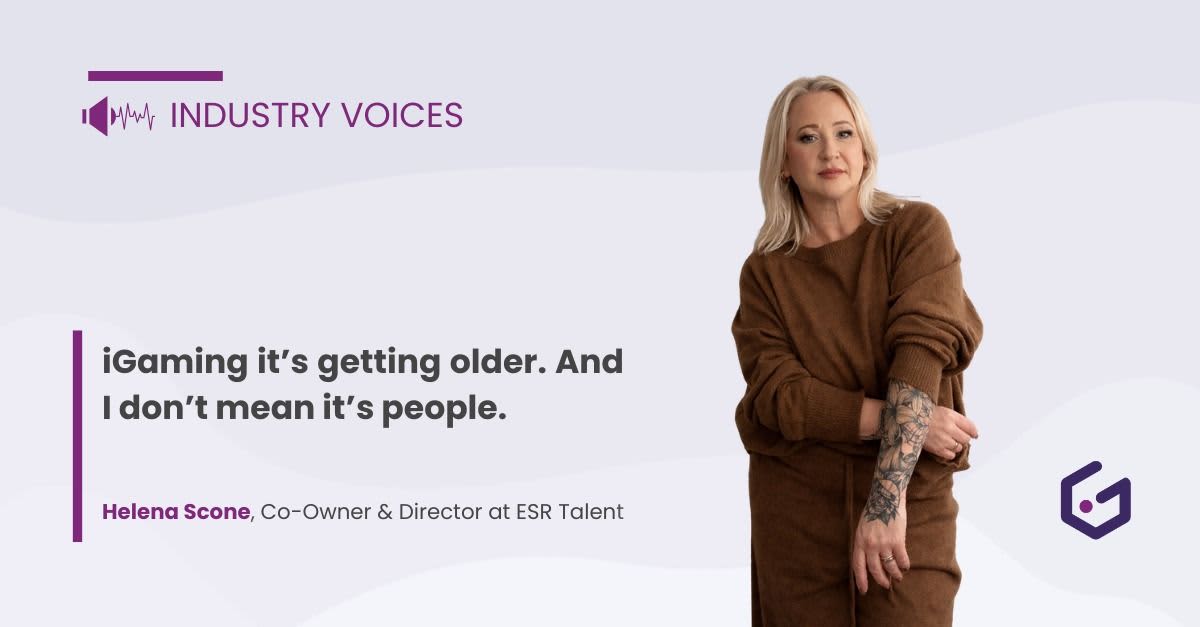
iGaming Is Getting Older. And I Don't Mean Its People.
I fell in love with iGaming at LeoVegas.
I’d already been recruiting externally in the industry for many years before, but it was when I moved internal that I really felt it.
That probably tells you quite a lot about the industry at the time, because when I joined, Leo was still a start-up and felt like a completely different world from the more traditional corporate environments I'd come across in my career.
It was fun. A little frivolous, a little chaotic, and full of people building things, figuring things out as they went and, importantly, enjoying themselves while they did it.
I remember Gustaf coming in and having a coffee most days. Not sitting behind some huge executive wall somewhere but being around the business and the people. It sounds like such a small thing now, but those are the things you remember.
And then there was the skiing trip to Kitzbühel to celebrate the first year. The whole company went, and I remember the customer service team and tech support basically taking over a conference room in the hotel. It wasn't some carefully choreographed corporate away day where everyone was encouraged to "network" before heading off to the next session. It just felt like everyone had been thrown together because we'd achieved something together.
I remember thinking that we really were part of something.
Funnily enough, I'm not a gambler and never have been, but I fell in love with the people, the energy, the slightly irreverent attitude and the feeling that you could walk into a room with an idea and, if you could convince someone it was worth doing, actually go and do it.
I've now been recruiting into iGaming for 17 years, so I've had a pretty good seat from which to watch the industry grow up. And it really has. It's bigger, more sophisticated, more regulated and much more professional than it was when I started, and that's obviously a good thing.
And I think iGaming is getting older, I don't mean its people (although some of us are!) Imean the industry itself.
Growing up isn't the problem
I'm definitely not suggesting that iGaming should somehow go back to the Wild West. The industry needed to mature, regulation needed to improve, businesses needed better governance, compliance needed to become more sophisticated, technology needed to evolve and, as companies get bigger, they inevitably need more structure and people who know how to operate at scale.
That's just business.
The problem isn't growth, it's what sometimes gets lost along the way.
When a company grows, you can gradually lose the spontaneity, the entrepreneurialism, the willingness to try something slightly ridiculous, the ability to make decisions quickly and, perhaps most importantly, the feeling that the people at the top actually know what's happening on the ground.
Culture is very easy to talk about when you're 50 people, it's considerably harder when you're 5,000.
I've seen what happens when start-ups grow up
When you're small, everyone has to be resourceful because you simply don't have another option. You don't have a huge finance team, three layers of product management or an army of people whose job it is to support every decision.
So people figure things out. They get involved in things that aren't technically their job, make decisions, pick up the phone, solve problems and probably make more mistakes along the way. But they move.
Then the company grows, and suddenly there are teams for everything. Processes are introduced, more approvals are needed and more people become involved in decisions. Before you know it, the person who was once responsible for figuring out how to solve a problem is filling in the form to ask someone else to solve it.
And yes, I'm exaggerating.
A little.
But we've all seen it.
There is a point where structure stops enabling growth and starts slowing it down, and I think the best companies are the ones that manage to grow without completely losing that original sense of energy.
At some point, someone created a Jira ticket
There is probably also a generational thing happening here.
I'm Gen X, and I've spent most of my career watching technology go from something that was supposed to make our lives easier to something that occasionally creates three additional systems so we can request permission to use the first system.
I'm also at the stage of life where my patience for unnecessary process is... let's call it selective.
I have absolutely no interest in opening three Jira tickets because I thought my team might work better if I moved a few desks around (yes this happened) I don't need a workflow, I need to move the bloody desks.
There is something quite funny about watching a business that once prided itself on being entrepreneurial slowly develop a process for everything.
Need to change a desk allocation? There's a process.
Want to try something different? Better have a meeting.
Need approval? Another meeting.
Need approval to change the meeting? Probably a Jira ticket.
And somewhere along the way, something that used to take ten minutes now takes ten days.
Of course, I'm being slightly unfair, but there is a serious point underneath it, processes are supposed to support people; they shouldn't become the work.
Perhaps one of the advantages of being a slightly older Gen X recruiter is that I've been around long enough to remember when we just did things. Sometimes badly, sometimes brilliantly, but we did them. I'd quite like to keep a little of that.
I'm not saying Gen X has all the answers, we absolutely don't. We've got a worrying relationship with fax machines and still think we can remember every password.
But there is something valuable in having spent part of your career in environments where you were expected to use your judgement.
And judgement is going to become increasingly important, particularly as AI starts taking away some of the repetitive work. The future isn't going to need more people who are exceptionally good at following a process nobody has questioned for five years. It's going to need people who can look at something and say, "Why are we doing it this way?" and then come up with a better answer.
The perfect candidate who wasn't
This brings me to one of the biggest lessons I've learned through recruitment.
A few years ago, I was working with a start-up whose CEO was very clear that they wanted someone with Tier One experience. On paper, it made perfect sense. They wanted someone who had operated at a high level, understood the industry, worked in a sophisticated environment and had seen scale.
And I found exactly that person.
It went badly.
Really badly.
The problem wasn't that the person wasn't capable, they absolutely were. The problem was that what had made them successful in a much larger organisation wasn't necessarily transferable to a small, fast-moving start-up.
They were used to having a much wider support system around them and in the start-up, those people didn't exist. There was a problem, and they had to solve it, so the person who looked perfect on paper wasn't necessarily the person the business needed.
That experience has stayed with me because we talk so much about hiring for experience, when perhaps we should be talking much more about hiring for environment.
Being successful in one environment doesn't make you successful in another
It's something I think companies get wrong all the time.
Someone has been successful at a huge operator, so we assume they'll be successful at a start-up. Someone has worked at a start-up, so we assume they'll be able to operate inside a large corporate. Someone has managed 100 people, so we assume they'll be happy managing 10.
Over time I've become much more interested in how someone works than simply where they've worked.
Give me someone who has had to figure things out with very little support and they'll probably be very comfortable in a start-up. Give me someone who has spent years operating within a highly structured environment and they may be exceptional at scale.
Neither is better. They're just different.
And I think our obsession with impressive logos and Tier One experience sometimes makes us forget that.
We're very good at hiring people we already know
I've spent many years watching people move around iGaming. Operator to operator, supplier to supplier, platform to platform, competitor to competitor and there is a reason for it, but there is a point where familiarity becomes a substitute for imagination.
If everyone hiring has spent their career in iGaming, and everyone being hired has spent their career in iGaming, we can end up with an industry that is very good at repeating what it already knows. That's not necessarily innovation, it's refinement.
Maybe the next great iGaming hire doesn't come from iGaming
This is where I think the industry has a huge opportunity.
Why couldn't your next CRM leader come from another subscription business? Why couldn't your payments expert come from fintech? Why couldn't your product leader come from gaming? Why couldn't your growth person come from SaaS? Why couldn't your fraud specialist come from banking?
I've recently found myself looking much more closely at industries outside traditional iGaming, and one of the things that strikes me is how much overlap there actually is.
So why wouldn't we look at what those industries are doing? Sometimes the most useful person in the room is the person who doesn't think like everyone else in the room.
And then there's AI
Of course, we can't talk about the future of iGaming without talking about AI.
There is a lot of conversation about AI replacing jobs, but I'm much more interested in what it does to the jobs that remain.
We're already seeing businesses think differently about headcount: smaller teams, more automation, fewer people doing more. That means the people left behind need to be different too.
If AI removes some of the repetitive work, the value of human beings increasingly sits in judgement, creativity, leadership, relationships, decision-making and the ability to operate in ambiguity.
Perhaps we're going to need fewer people who can simply do the thing, and more people who can figure out what the thing should be in the first place.
That's going to change hiring, and I don't think we're anywhere near the end of that conversation.
Perhaps the industry needs to get a little uncomfortable again
Again, this isn't an argument for going backwards. I've seen how much better it has become, and I've seen the professionalism, technology, opportunities and huge businesses that have been built.
Growth is good. Scale is good. Professionalism is good.
But we do need to be careful about what we leave behind when we grow.
The things that make a company great when it's small don't necessarily disappear because they're no longer needed, sometimes they disappear because nobody actively protects them.
The CEO stops having coffee with people, the founders become increasingly removed from the day-to-day, decisions take longer, people become more cautious, job descriptions get longer and processes multiply.
And suddenly the company that once attracted people because it was different starts looking a lot like everyone else.
Maybe that's the real challenge for mature iGaming
I don't think the industry has run out of ideas, and I definitely don't think the best days are behind it. Quite the opposite. I think we're entering a really interesting period.
AI is changing how teams work, crypto continues to challenge traditional models, new technology is changing payments, identity, fraud and acquisition, and new industries are overlapping with iGaming in ways that would have seemed strange a few years ago.
There are still plenty of people willing to take risks, we just need to make sure we're still giving them room to do it.
Because the danger for a mature industry isn't necessarily becoming boring, it's becoming too comfortable.
Too comfortable hiring the same people. Too comfortable asking for the same experience. Too comfortable following the same models. Too comfortable saying, "That's how it's done."
So, is iGaming getting older?
Yes.
And growing up isn't a bad thing. But I think there's a difference between becoming mature and becoming corporate. There's a difference between having structure and losing spontaneity. There's a difference between managing risk and avoiding it. There's a difference between hiring experience and hiring familiarity.
And there's a difference between scaling a company and scaling away the culture that made people want to join it.
I fell in love with iGaming because it felt different so I'd like to think we can grow up without completely growing out of that.
Because companies have to get bigger, industries have to mature, but they don't have to stop being interesting.
I'd like to see more curiosity again, more challenging conversations, more people asking, "Why?" And, occasionally, someone still brave enough to say, "What if we just tried it?"
Categories
Enjoyed this story?
Add OnlyiGaming as a preferred source on Google to see more of our reporting.