01.09.2026 · 11 min read
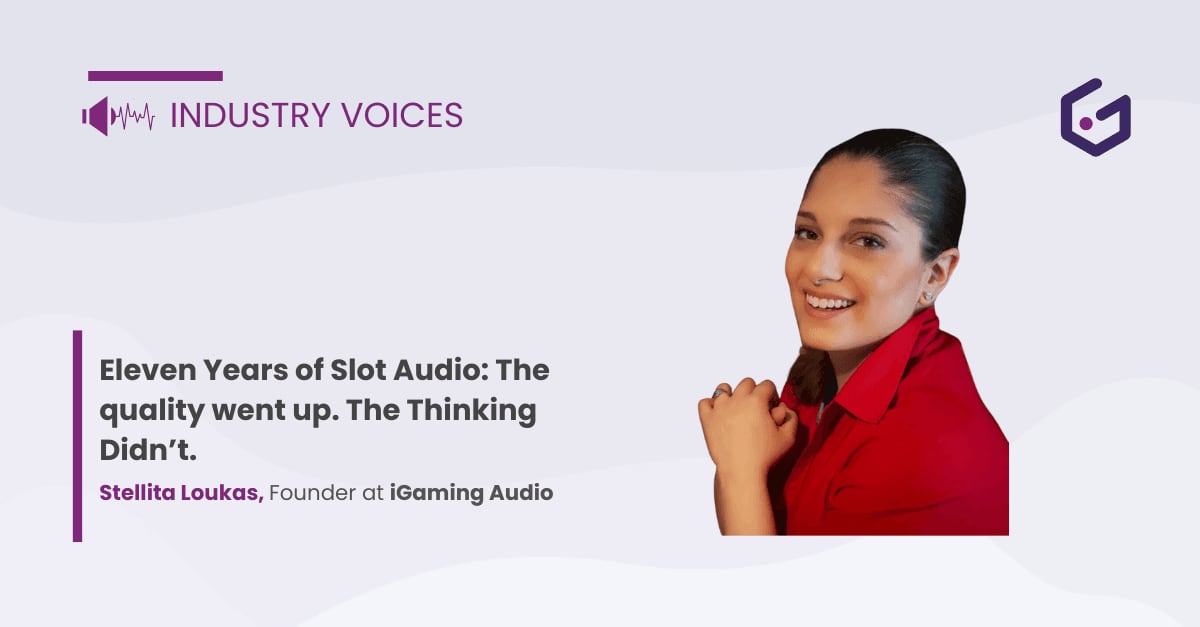
Eleven Years of Slot Audio: The Quality Went Up. The Thinking Didn’t.
In 2015, the entire soundtrack of a slot game had to survive a decision that had nothing to do with music: how long a player on a bad mobile connection would wait before closing the tab.
That was the real brief. The reel spins, the stops, the anticipation, the fanfare, the loop that had to sit under a fifteen-minute session without becoming a headache — all of it had to fit into whatever was left of the package once the art was in. I spent more time in compression dialogues than making the actual sound.
The written brief, when there was one, was a sentence. Egyptian, make it exciting. The reference material, when there was any, was a AAA title or a film score — an aesthetic produced by a department of forty people with a budget to match, handed to one person exporting for €12 earbuds on a bus. The ambition was borrowed from productions a hundred times the size. The line item was not.
But the file size ceiling was only the visible constraint. The one underneath it was an assumption, and it was said out loud in meetings: audio doesn’t matter that much, because players turn it off anyway. Sound wasn’t a system to be designed, it was a cost to be kept down — and the muted player was the argument that justified keeping it down.
So the first half of my career wasn’t spent designing audio. It was spent making the case for it: persuading developers to part with a few thousand more on a budget that had already been signed off, for a discipline nobody could point to on a retention chart.
What changed it was a small number of producers and studio heads who had noticed something obvious. A game whose art had been through eleven rounds of polish and whose audio had been through one does not feel finished, and players can tell even when they cannot say why. Their argument was that the audio should match the quality of the graphics. They were right, and over several years they won.
None of it was strategic, and it didn’t need to be — the constraints made most of the decisions for us. But look at the shape of the argument we were winning. It was an argument about money and quality. Nobody in those meetings, including me, was arguing about who should decide what a game sounds like. We were asking for a bigger budget, not for a seat.
What we built
Then the constraints disappeared one by one, and the craft got very good.
The technical ceiling lifted first. Flash gave way to HTML5, the Web Audio API arrived, and middleware that had been standard in console development for two decades started appearing in the bigger slot pipelines. Loops became layers. Static beds became adaptive systems that respond to game state instead of just running underneath it.
Mobile changed the listening context entirely. The target stopped being a desktop browser in a quiet room and became a phone speaker, a pair of earbuds, or — hold onto this one — no audio at all, because a large share of sessions are played in public with the sound off. The muted player never went away. He was simply promoted from an excuse for underspending to a fact nobody designs for.
New mechanics forced new audio thinking. Cascading reels made escalation compulsory: you cannot run six consecutive cascades on a flat sound and keep a player’s pulse up. So slot audio developed pitch-ramping sequences, tension states, tiered win architectures and near-miss cues with real design behind them. Note where that came from — the most useful audio idea of the decade in this sector was borrowed from mobile puzzle games, not from casinos. Streaming added a second borrowed lesson: once win moments were being heard by thousands of non-players, they quietly started being engineered for clip-ability, a marketing function that appears in nobody’s job description.
And the supply side professionalised: specialist audio studios, real composers, licensed music with budgets behind it. A low-tier release in 2026 sounds better than a flagship did in 2016, and that is measurable in the mix, not nostalgia.
So the tools improved, the budgets improved, the talent improved, and the constraints that used to make our decisions for us are gone.
Where that leaves us
Play twenty new releases back to back. Properly — headphones, sound on, an hour of your life.
You will hear twenty competent soundtracks. Clean mixes, reasonable orchestration, sensible loudness, win escalation that works. You will struggle to name a single decision that was made.
Everything is well made. Almost nothing is chosen.
Ask a studio what its portfolio is supposed to sound like and you will usually get an answer about individual games — this one is Egyptian, this one is a fruit machine homage. That describes themes, not a sonic identity. A studio that would never ship forty different logos ships forty different sound worlds a year without anyone raising a hand. A sound world isa logo — it does the same job, recognition without explanation. It simply isn’t drawn, so nobody guards it.
This is the point where the sound designer traditionally complains that nobody listens to them. That is not the argument. Sound designers execute — they are handed a vision by an art director, a game designer or a producer, and they realise it, usually better than it was described to them. They are, on the whole, very good at that. The problem sits above them, in a room they were never invited into.
Three gaps that are not about talent
There is no proper brief, because no artefact exists that could hold one. Art has a style guide. Maths has a spec and a PAR sheet. Production has a schedule and a gate structure. Audio has a Slack message and two reference links — and it usually arrives after the art is locked, the maths is signed off and the mechanic is final, at which point sound can only decorate a game it can no longer shape.
This is the mechanism by which the thinking fails to happen. A document forces decisions into the open. If a studio had to write down, before a note existed, what a game’s sonic premise is, which sounds sit at the top of the hierarchy and how the win tiers escalate against each other, somebody would have to decide those things. None of it is exotic. Every item is answered in every finished game — retroactively, one thread at a time. It has simply never been anyone’s job to answer them in advance.
Nobody owns the decision. Put this question to any studio: who makes the final call on what a game sounds like?The honest answers are “the producer,” “the art director, sort of,” “it depends,” and “whoever replies in the thread.” Several people hold partial input. Nobody holds authority.
That is not a failure of the people in the room. An art director has an art director’s training; a producer has a producer’s. Neither has spent ten years thinking about how a win tier should escalate against the one below it, or what a game sounds like on its four hundredth spin — and neither should have to. They are ruling on a discipline they were never trained in because the org chart left the seat empty and somebody had to sit in it. Every other creative decision in a slot has a named owner who signs it off. This one has a committee, and a committee’s aesthetic is always the average of what nobody objected to.
Which leaves a studio staffed with people who can decide but cannot specify, and people who can specify but are never asked to decide. What is missing is whoever stands between them: enough audio experience to hold a strategic conversation with game design and production, and enough craft experience to turn the outcome into instructions a sound designer can actually build from. Both halves are the job. Neither half on its own is.
Audio is the last un-instrumented part of a hyper-instrumented product. This industry A/B tests button placement, thumbnail art and the wording of a bonus buy confirmation. Nobody tests audio the way it should be tested. With real data. From actual players.
Testing does happen — but look at what it is for. QA hunts defects: a loop that doesn’t loop seamlessly, a cue sitting too loud in the mix, anything likely to irritate a player into muting. Product owners, game designers and producers add a second layer, judging whether the audio suits the theme and whether it starts grating by the fiftieth spin. Both passes are worth doing. Both ask whether anything is wrong with the audio. Neither asks whether it does anything.
Whether the data exists somewhere, I cannot say. Studios measure a great deal, and some of it may well touch audio state. What I can say is that in eleven years it has never reached the people making the sound: no session length split by sound-on versus sound-off, no retention segmented by audio state, no brief that opened by telling me what the last game’s audio actually did. If those numbers exist, they are not in the loop that produces the work — and for the purposes of the next decision, that is the same as not existing.
Which produces a neat trap: the one discipline running purely on taste then gets dismissed as subjective. It is subjective because nobody closed the loop, and nobody closed the loop because nobody owned it.
The proof is already published
If that sounds like an aesthetic complaint, consider a case where the stakes are not aesthetic.
Since February 2021, the UK Gambling Commission’s technical standards have included RTS 14F: “the gambling system must not celebrate a return which is less than or equal to the total stake gambled,” with guidance clarifying that auditory effects associated with a win are not permitted for those returns. In plain terms, a spin returning less than the player staked must not sound like a win. It is a regulatory requirement living almost entirely inside sound design.
In 2026, researchers publishing in Behavioural Public Policy observed 1,904 bets across 26 popular UK online slots and found 17 of them still using win-associated sounds after losses disguised as wins. A listening task with 400 UK gamblers supported the classification: participants heard most of those below-stake sounds as positive.
Five years. A rule squarely in the audio department’s lane. Products from studios with capable audio teams and real budgets.
That is not a craft failure — making a below-stake return sound neutral is the easiest thing on the list. It is an ownership failure. When a requirement sits between compliance, game design and audio, and no one owns the audio answer, it falls into the gap and stays there.
If that gap can swallow a regulatory obligation, it can certainly swallow a creative one.
What would have to change
None of this is expensive, and none of it requires a hire.
Name the owner — one person per title who holds the sonic answer and signs it off, with the authority and the accountability that implies. Write the brief before the build; two pages is enough, and the decisions it forces are the point. Move the conversation upstream, to greybox rather than pre-certification. Instrument something — sound-on rate, session length by audio state, anything; the first studio holding real numbers will have an argument nobody else can make. And design for silence as a first-class state, not a degraded one.
There is a name for the discipline that does this, and it isn’t sound design. Sound design is the making. What’s missing is the deciding — and the translating between the people who decide and the people who make.
The thing I didn’t expect
I assumed in 2015 that the constraints were the enemy — that if the file sizes and budgets and tools improved, the work would become as considered as work in any other medium.
We won that argument. Audio got the money, the tools and the talent, and the quality followed exactly as we said it would. What we never asked for, because it never occurred to us to ask, was the authority to decide what any of it was for. We spent a decade arguing that audio deserved to be taken seriously, and won a budget instead of a seat.
The next decade of slot audio won’t be won on production quality. That argument is over; everyone won it. It will be won by whoever decides to actually decide.
Sources
UK Gambling Commission, Remote gambling and software technical standards, RTS 14F — responsible product design (published 2 February 2021). gamblingcommission.gov.uk
Myles, D., Bennett, D. B. & Newall, P. (2026). “Cue the sad trombone: UK gambling regulations have not prevented the misuse of celebratory sound effects in online slots.” Behavioural Public Policy, Cambridge University Press.
Categories
Enjoyed this story?
Add OnlyiGaming as a preferred source on Google to see more of our reporting.

Comments (0)
No comments yet. Be the first to share your thoughts!