26.08.2026 · 6 min read
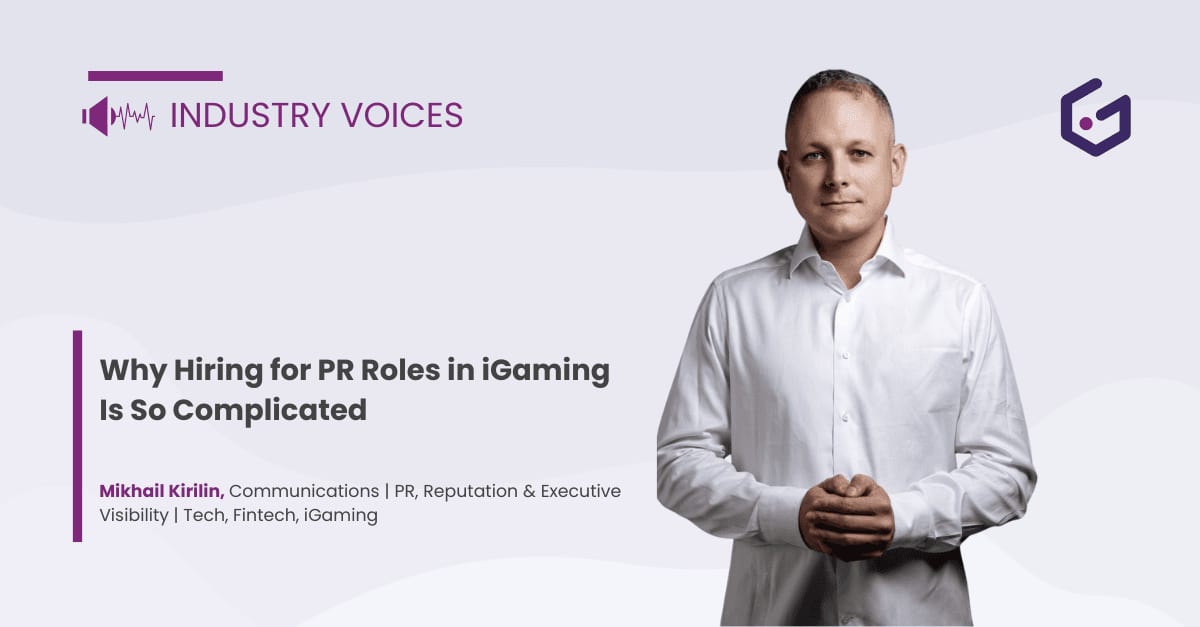
Why Hiring for PR Roles in iGaming Is So Complicated
The problem faced by an experienced public relations specialist in the iGaming sector is not a lack of skills, but rather that the market finds it difficult to categorise, assess and properly value these skills.
Around 10 years ago, it was fashionable in the IT industry to talk about the ‘T-shaped model’, which was used to describe horizontal growth: this is when a professional develops expertise across a range of tasks in related fields. In iGaming, this is nothing new, as the rapid pace of change often requires involvement in sales, lead generation and event organisation. As a result, the skill set expands, but the ability to demonstrate and categorise these skills does not always keep pace.
This is not unique to iGaming. CIPR’s 2024 State of the Profession report identified the expanding skill set required of individual practitioners and the loss of specialisation as one of the profession’s major challenges, cited by 30% of respondents. Convergence with other disciplines was cited by another 21%.
In the public relations sector, the ‘T-shaped’ model can extend as far as the responsibilities of a product marketing manager. This often means that the role is defined by a senior executive or head of marketing, whose immediate business needs may influence the job description more than the traditional framework of PR. The scope of the role expands, while the salary level may still be benchmarked against a traditional PR role.
Where PR ends and other functions begin
It’s always been difficult to explain exactly what we do in PR. When I tried to launch my agency, this became the main pain point: clients’ lack of understanding and their distorted perceptions of brand communications. To put it simply, the roles of Head of Media and Media Buyer have nothing to do with media relations.
In practice, this results in several recurring types of vacancies:
A blend of PR, ORM and SERM. PR professionals should have the necessary expertise to address these areas. The difference is that reputation management often involves a large amount of repetitive day-to-day work. Reputation management may support monetisation, but ultimately it is built around the real experience of people interacting with the product.
A blend of PR and performance marketing. These are adjacent disciplines, but their objectives are fundamentally different. PR may be required to meet conversion metrics, including lead-gen goals. Within a public relations vacancy, we might find the responsibilities of an affiliate manager, with candidates being asked during the interview whether they have a portfolio demonstrating traffic generation.
PR Events Manager. Here I see potential: major trade shows like SiGMA, SBC and iGB have their own media networks, and this can create greater synergy. But need I say that events also involve merchandising and stand construction?
PR and whatever. It may include PPC, SEO, SERM and much more. Very recently, I came across a “PR & Marketing” vacancy that required three years of experience in filming and video editing, as well as knowledge of AI tools used by videographers.
The options mentioned above can be combined simultaneously. I don’t disagree that a PR professional should be an expert in all the areas mentioned, especially as they are all interesting and provide valuable experience. What I’m talking about here is the old trick of hiring one person instead of two or three.
Cross-functional experience itself is not the problem. PRSA’s current career guidance even presents cross-functional reach as an indicator of seniority. The problem begins when collaboration with another function turns into ownership of that function.
PR can make its own expertise invisible
Outside the iGaming sector, I worked for a long time on a project that adopted a public relations approach often associated with highly private financial firms: almost no information was released to the outside world. Such a restriction can unleash creativity when part of the strategy is devoted to engaging with external narratives, such as financial analysis.
In iGaming, despite the dynamism and visibility of the sector’s expertise, restrictions can boost creativity, while risk slows down the process with endless approvals and limitations. PR specialists accumulate skills that are difficult to demonstrate in a portfolio, let alone through original publications, due to the frequent use of NDAs.
Much of this work is not publicly attributed to the PR specialist behind it. As a result, professional experience may grow much faster than the visible evidence of that experience.
The project-based nature of the profession and fluctuating job grades
Professional growth in PR is easier to assess in terms of the complexity and scale of the tasks undertaken than by using a universal set of metrics. In addition to the ‘junior’, ‘middle’ and ‘senior’ levels, progression up the career ladder often depends on the organisational structure: responsibility for a team, budget management and access to senior management.
At this stage, promotion to a managerial role often depends on trust and personal relationships rather than on achieving specific metrics such as Share of Voice, Engagement Rate and the number of award nominations secured.
When internal career progression becomes uncertain, the logical next step may seem to be a move into independent consultancy or setting up one’s own agency. It is precisely at this point that the lack of visible career capital becomes particularly painful.
The challenge of starting a business
My favourite question to ask myself is: can I explain what public relations is?
A few years ago, together with a few other specialists, I tried to set up an agency by offering clients in the fintech sector a free brand audit, followed by a brief strategic proposal. We came across a number of founders who were not prepared to make long-term investments. The volatility of income, for example, among brokers, raises doubts both about investing in public relations and about taking on additional staff.
Having studied agencies’ portfolios, I have come to the conclusion that the value of a proposal is influenced by the agency’s reputation, as evidenced by its long track record in the market and the awards it has received for major public projects.
By working in “black boxes” or casinos that are completely closed off from public scrutiny, we as professionals may miss the opportunity to lay the foundations for our own reputation. This may only become apparent years later.
And this is where the real problem with a T-shaped career becomes visible: you may spend years building expertise without building an equally visible professional reputation.
What's the final piece of advice? Build your portfolio with everything you can, write blogs, and do competitor research. Attracting attention is a key communication skill, so you need to learn how to practice it first and foremost on yourself.
Categories
Enjoyed this story?
Add OnlyiGaming as a preferred source on Google to see more of our reporting.