21.09.2026 · 7 min read
How Many NDCs Did Programmatic Bring? A Fair Question That Deserves a Better Answer
Every marketing meeting in iGaming has this moment. Someone from the board, from finance, or the founder himself asks: "How many NDCs did programmatic bring us this month? How many from affiliates?"
It's a fair question. The budget owner has every right to ask it, they're paying for the channel and want to know what they're getting back. The problem isn't the question. The problem is the answer it usually gets.
The standard answer is a single number, pulled from one source, presented as if it were the whole truth. Sometimes it's in-channel data, the platform crediting itself for the conversion, on rules it set itself. Sometimes it's GA4, which in theory should be the neutral referee, but in practice often runs on a misconfigured attribution model, poorly defined conversion events, and at higher traffic volumes, sampling on top of that, so the number that looks precise is actually an estimate from a partial sample, not a full count. Sometimes it's an affiliate tracking link, which is often used to track programmatic traffic too. The tracking code says "this click is mine" without saying anything about what happened with that player before.
Each of these three methods produces a number. None of them produces the full picture. Simple, fast, defensible, and practically always incomplete.
Two Platforms, Two Different Definitions of Success
Programmatic and affiliates aren't just different channels. They're different platforms, running entirely different reporting logic. Different attribution windows. Different weighting of postview versus postclick. Different campaign strategies deciding what gets counted in the first place.
Put "NDCs from programmatic" next to "NDCs from affiliates," pulled straight from their own platforms, and you get two numbers measured with two different rulers, presented as if they belonged to one coherent system. This isn't a lie. It's an incomplete picture handed over as a complete one.
And that's just the channel level.
It Goes Deeper Than the Channel
Inside a single channel, you already have prospecting and retargeting. Two different missions, usually collapsed into one line in a report. Prospecting brings in new players. Retargeting closes them. It's not the same job just because it comes out of the same dashboard.
This has a direct effect on the budget. Say your problem is a lack of fresh blood, not enough new players entering the funnel. You shift budget toward prospecting, even if its direct conversion rate looks weaker than retargeting's. Say the problem is a low conversion rate with plenty of traffic already coming in. You do the opposite. These are two different decisions. "Meta has this much budget" as a single line in a report doesn't let you make either one consciously.
Add brand awareness to the mix, and another layer stacks on top: programmatic, organic social, paid social. Each has a different mission. Each gets judged by a different success criterion. At this level, you're no longer separating channels, or even campaign groups. You're separating the specific mission behind each campaign.
A Better Question Than "How Many NDCs From Programmatic"
Which channel is actually hitting the goal you set for it? If prospecting's job is to bring in valuable traffic that converts, maybe not immediately, maybe through a different channel a week later, then its success shouldn't be measured by its own last click. It should be measured by whether that traffic converts anywhere in the funnel.
Take Adform, Sportradar, and Quantcast: three DSPs, each judged on prospecting by one question: does it bring in valuable traffic that converts, or does it just generate volume with nothing to show for it in deposits? Which one delivers stable, repeatable results? Which one looks good on entry and actually burns the budget on traffic that never comes back? The same question sits inside social media too, between Meta, X, and Snapchat. Do you actually know which of these platforms brings in valuable traffic on your top-of-funnel prospecting campaigns?
The channel that gets the last click gets all the credit. The channel that actually hit its goal, bringing in the player who ended up depositing, can look like a failure in the same report.
A Better Answer Exists
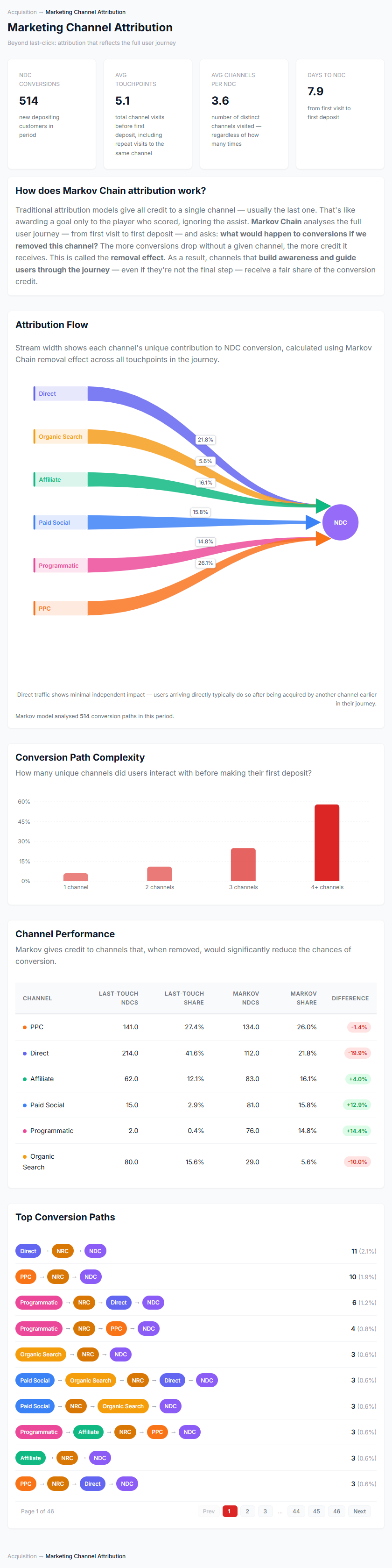
"How many NDCs from programmatic" has a simple answer and a fuller one. The simple one says: whatever the platform assigned itself. The fuller one says: on how many paths leading to a first deposit did programmatic even show up, at what stage, and what was its real contribution to the player's decision, even if the last click belonged to someone else.
That's the difference between "how much did the channel earn" and "how much did the channel actually contribute to the result." The first number is easy to pull and convenient to defend in a meeting. The second requires seeing the player's entire path, channels, campaigns, creatives, landing pages, from the first touchpoint to the deposit.
The Convenience Trap
Nobody in a meeting has the time or the patience for an answer that starts with "it depends on how we define success for this channel." It's easier to grab one number and move on than to break it down by mission: brand awareness, prospecting, retargeting, conversion campaigns (NRC to NDC).
Judging a channel as a whole is convenient. It doesn't require asking what goal you actually set for it, or whether that goal was met. Just look at one metric and either praise it or cut the budget. The problem is that convenience has a price, and you pay it in budget decisions made on an incomplete picture.
AOD:Analytics Sees the Full Path to FTD
AOD:Analytics is built from the ground up for iGaming. It knows the difference between NDC, RDC, and NRC, understands the logic of prospecting versus retargeting. It's an independent tool that shows the value of every traffic source, programmatic, affiliates, social, organic, in one picture of the player's path, from the first touchpoint to the first deposit.
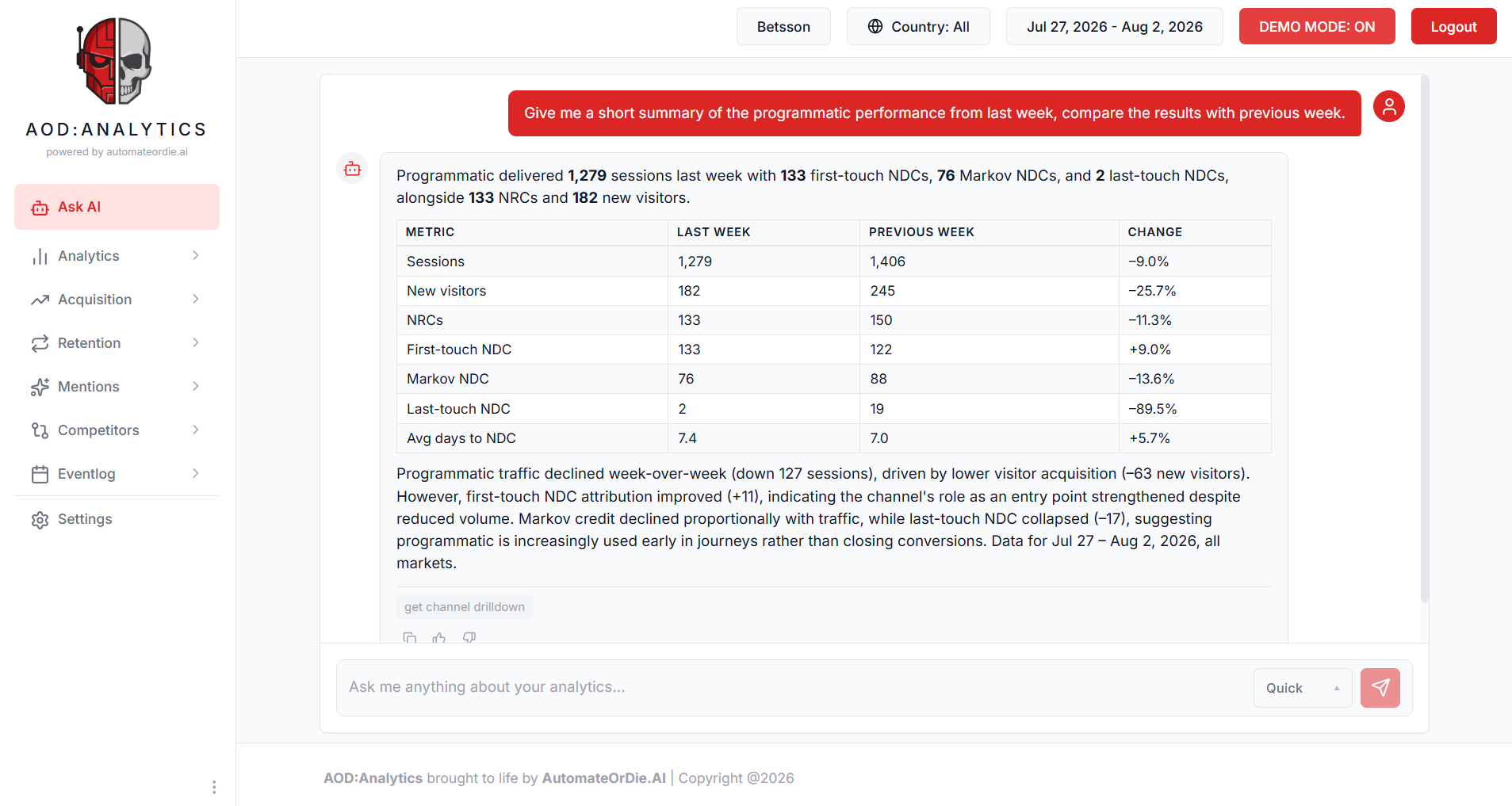
That means questions like "where are we overspending, where's the gap in the funnel, which channel is piggybacking on another one's work" stop being something you wait a week to answer by manually pulling data from five places. You get the full picture in seconds, by prompting the system like you would ChatGPT, except it answers based on your actual data, not general marketing knowledge.
The Right Insight, at the Right Depth
Quick Mode gives you a straight number when you need it on the spot. Strategic Mode goes further. It's a deep-reasoning model that analyzes your entire media mix and answers the questions that would otherwise sit unanswered for weeks: what would actually move the needle on NDCs, where to shift budget, which channel only looks weak because it isn't getting credit for the work it did.
The Bottom Line
The question "how many NDCs did programmatic bring?" isn't going away, and it shouldn't. What has to change is the quality of the answer, because the same answer is read three different ways in three different places in the company.
For the person asking. A board member, CFO or founder gets what they were actually after: not a number they have to take on faith, but a view they can defend. Which channel contributed to first deposits, at what stage, and at what cost. Budget decisions stop resting on whichever platform reported the most flattering figure. The answer is available in seconds, not after a week of waiting on a manual report.
For the marketing team. Nobody has to defend a channel by its last click alone. Prospecting is judged as prospecting, retargeting as retargeting, brand as brand. The team stops spending days pulling data from five platforms to reconcile numbers that were never comparable. That time goes back to what it should be spent on: testing, optimizing, building campaigns. And when a channel does the groundwork for a deposit that someone else closed, the work is finally visible.
For the business. Every euro of media budget gets allocated on evidence of contribution, not on convenience. Money moves out of channels that only look good in their own dashboard and into those that actually feed the funnel. Overspend and funnel gaps surface early, not at the end of the quarter. That is the mechanism of growth here: not spending more, but spending where the player's path shows it works.
Want to see it on your own data? Book a 30-minute consultation: automateordie.ai/#contact
Categories
Enjoyed this story?
Add OnlyiGaming as a preferred source on Google to see more of our reporting.

Comments (0)
No comments yet. Be the first to share your thoughts!