
26.08.2026 · 7 min read
Brazil’s next iGaming regulatory challenge is the B2B supply chain

Brazil has already taken significant steps toward building a regulated betting market.
The first phase naturally focused on operators. Licensing, advertising, payment methods, responsible gambling, KYC, consumer protection and technical requirements have all become part of the day-to-day reality for companies seeking to operate legally in the country.
The next phase, however, is likely to extend into the infrastructure that supports the entire market. For international B2B suppliers, this shift is particularly important.
Brazil is sending clear signals that the future of its regulated market will depend not only on operator compliance, but also on whether game providers, platforms, payment companies, KYC vendors, data and odds suppliers, affiliates and other service providers can meet local standards.
In other words, regulation is moving beyond the most visible part of the industry and deeper into the operational supply chain that makes the market work.
B2B suppliers are entering the regulatory perimeter
Brazil has not yet introduced a definitive regulatory framework specifically targeting B2B suppliers. But the direction is becoming clear.
The Secretariat of Prizes and Betting (SPA) has already held a public consultation and a public hearing to discuss the regulation of service providers contracted by betting operators.
The proposal is aimed at establishing minimum requirements and creating a process for recognizing the operational capabilities of these suppliers.
That would represent a meaningful shift.
If implemented, operators will no longer be able to select a supplier simply because its technology is good, fast to deploy or commercially attractive. They will increasingly need partners that are recognized as capable of meeting the standards established by the Brazilian regulator.
Depending on the final wording of the regulation, this discussion may cover game providers; platform providers, including PAMs and white-label solutions; payment providers, particularly those supporting Pix deposits and withdrawals; KYC, identity and risk-classification services; data, odds and statistics providers; integrators and aggregators; agencies, affiliates and other distribution or advertising channels.
For international B2Bs, compliance will no longer be solely the operator’s concern. Suppliers themselves are becoming part of the operation’s regulatory risk profile.
Brazil is targeting the infrastructure behind the illegal market
One of the clearest indications of this shift can be seen in how Brazilian authorities are approaching illegal gambling.
Enforcement is no longer focused exclusively on illegal betting operators and attention is increasingly turning to the infrastructure that enables them to operate.
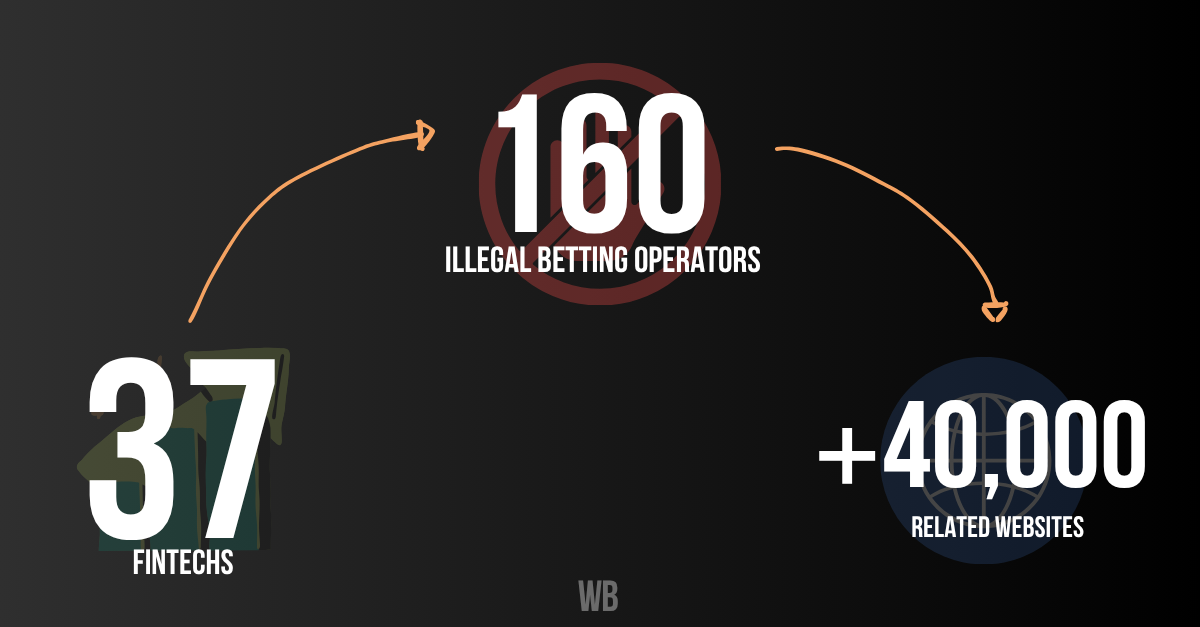
In July 2026, the Federal Government notified 37 fintech companies suspected of processing funds connected to illegal betting operations. According to reports, these companies were linked to transactions involving 160 illegal operators and more than 40,000 related websites.
The message is significant: if a supplier enables the illegal market to operate, whether knowingly or because its controls are inadequate, it may also face consequences.
This is the logic behind shared accountability across the supply chain.
A payment provider, platform, game aggregator or affiliate network may not be the operator facing the end user, but if it enables an illegal operation, processes its transactions, distributes its games or directs Brazilian users toward it, that supplier is increasingly likely to attract regulatory scrutiny.
This is why vendor due diligence is becoming more than a procurement exercise. It is becoming part of market governance.
Operators need to know who they are buying from. Suppliers need to know who they are selling to.
Compliance by design is no longer optional
Many B2B companies still approach compliance as a layer added after a product has already been built. That model is increasingly difficult to reconcile with the Brazilian market.
Brazilian requirements can directly affect technical architecture, APIs, data flows and operational controls.
KYC is a good example.
A platform or technology provider cannot focus exclusively on product performance. Its systems also need to support an operator’s ability to prevent unverified users from betting, block minors, integrate CPF and biometric verification, and avoid gaps between registration, identity verification, deposits, betting activity and withdrawals.
Payments are another example.
Pix has become central to the betting experience in Brazil. But instant payments also reduce the amount of time available to detect suspicious behavior, unusual patterns and inconsistencies between the person registered on the platform and the person actually moving the money.
For payment providers, this creates a direct technical challenge. The payment journey must support controls such as matching the CPF of the bank account holder against the CPF registered and verified with the operator.
The prohibition of third-party payments may sound like a compliance policy. Technically, however, it is also an API, database and integration problem.
If the technology cannot enforce the rule, the operation remains exposed.
Integration has become a compliance issue
One of the most underestimated risks in regulated markets is poor integration between systems.
Many companies can deliver a strong product in isolation, but the real test is whether that product can perform reliably inside a regulated operational environment.
Can System A communicate properly with System B?
Does the KYC provider integrate correctly with the platform?
Can the payment provider read the correct player status before approving a transaction?
Can the operator reconstruct a decision six months later?
Can the supplier demonstrate when a decision was made, which data supported it and which rule was applied?
Those are compliance questions.
Native integration is likely to become even more relevant in Brazil because many operators do not have large in-house engineering teams available to build and maintain complex integrations manually.
A supplier that requires excessive development creates friction. One that fragments data creates risk. And one that cannot preserve a reliable audit trail may become increasingly difficult for regulated operators to onboard.
What international B2Bs should start doing now
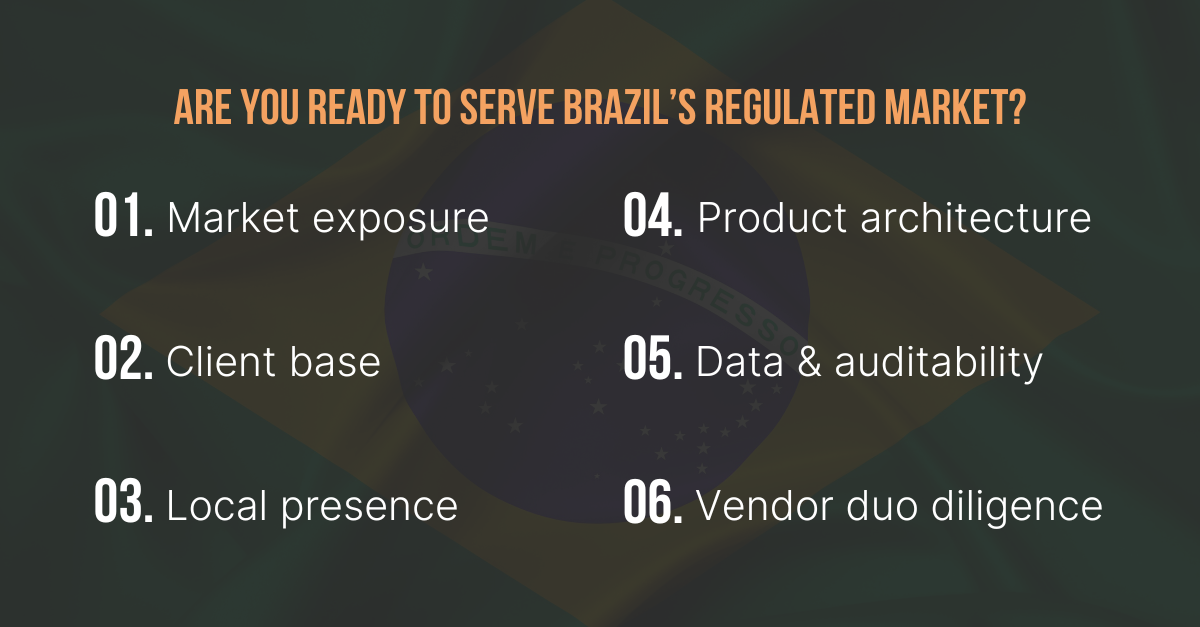
The final regulation has not yet been published. Waiting for the definitive text before preparing, however, may prove costly. International suppliers looking to serve licensed Brazilian operators should already be developing a regulatory readiness plan.
The first step is to map their exposure to Brazil. Does the company provide games, platforms, payments, KYC, data, odds, integrations, advertising, affiliate services or another function that is essential to the operation?
The second is to review the client base. Suppliers should be able to demonstrate that they are not providing services to illegal operators targeting the Brazilian market.
The third is to prepare for local representation. Even if a Brazilian legal entity is not required in every case, having a local legal representative or attorney-in-fact is likely to become relevant. A local structure may also reinforce transparency and demonstrate long-term commitment to the regulated market.
The fourth is to audit product architecture. Can the systems support CPF verification, biometric integration, age restrictions, payment controls, logging, traceability and responsible gambling requirements?
The fifth is to review data governance. Suppliers need to understand what data they receive, where it is stored, how long it is retained, how decisions are documented and whether historical information can be reliably reconstructed.
The sixth is to prepare a robust vendor due diligence package. Operators will increasingly need evidence that their suppliers are trustworthy, compliant and technically prepared for the Brazilian regulatory environment.
The seventh is to build compliance directly into the product. Compliance cannot be a toll booth placed halfway down the road, it needs to be part of the road itself.
Brazil is not only regulating operators, it is regulating trust.
Brazil’s betting market is entering a more mature phase.
At the beginning of the regulatory process, the central question was whether operators would be licensed, but now is if we can the entire supply chain support a regulated market.
That includes operators, but also the companies behind the interface, the games, the payments, identity verification, data and player acquisition.
For B2B suppliers, this should not be viewed solely as a regulatory threat, but also as a commercial opportunity.
Companies that understand the direction of Brazilian regulation early will be better positioned to serve licensed operators, reduce friction during procurement and onboarding, limit their exposure to the illegal market and build long-term relationships in one of the world’s most relevant betting markets.
Brazil is open for business, but not for regulatory shortcuts.
The companies that understand this first will be better prepared for the market’s next phase.
Categories
Enjoyed this story?
Add OnlyiGaming as a preferred source on Google to see more of our reporting.

Comments (0)
No comments yet. Be the first to share your thoughts!