30.04.2026 · 9 min read
The Rise of Evolution: From Riga Startup to $13.7 Billion Giant
The Rise of Evolution: From Riga Startup to $13.7 Billion Giant
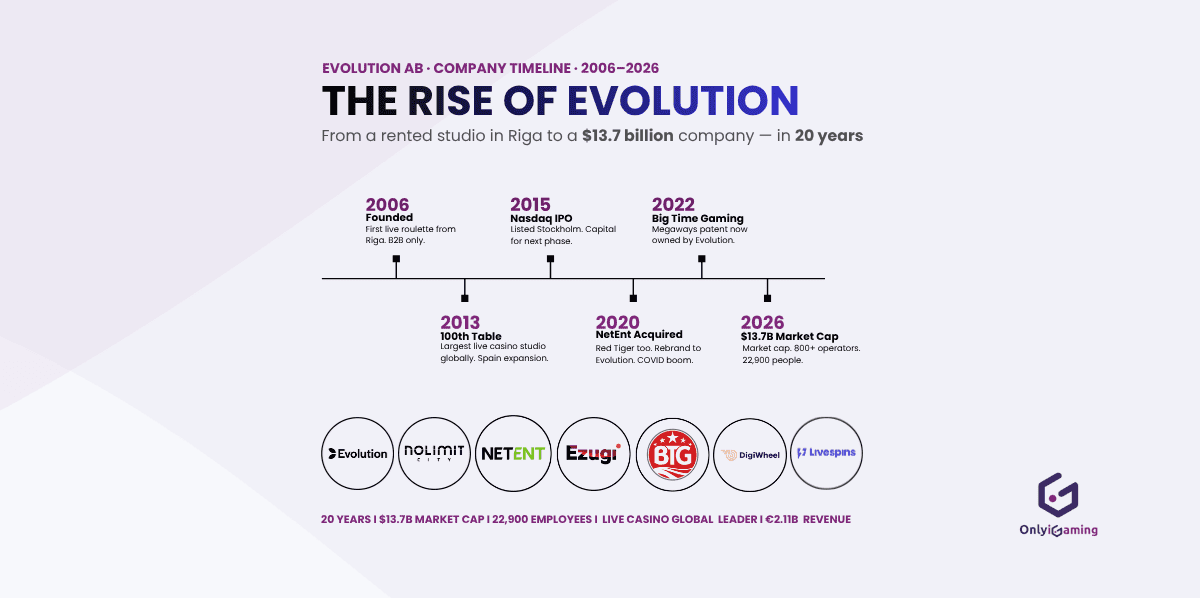
In 2006 two Swedish entrepreneurs rented a studio in Riga, Latvia, hired a handful of dealers and started streaming live roulette to online casino operators across Europe. Nobody in the industry paid much attention.
Twenty years later that company — Evolution — is worth approximately $13.7 billion, employs around 22,900 people across studios on four continents, and holds a dominant position in the global live casino market. It is one of the most remarkable business stories in European tech.
This is how it happened.
2006 — The Beginning
Evolution was founded on April 26 2006 by Jens von Bahr and Fredrik Österberg in Stockholm, Sweden. Their idea was straightforward but bold. Online casinos at the time were entirely powered by random number generators. The games were digital, the outcomes were computed, and many players simply did not trust them. Von Bahr and Österberg believed that streaming a real dealer playing a real game in real time would solve the trust problem and create an entirely new category of online casino product.
They opened their first studio in Riga, Latvia, chosen for its combination of affordable operational costs, a highly educated workforce and strong broadband infrastructure. The first product was live roulette, streamed via video to operator partners who embedded it directly into their casino websites. Evolution operated purely as a B2B business from day one — they never dealt with players directly, only with the operators who licensed their platform.
The model was capital intensive. Building studios, training dealers, investing in video infrastructure and maintaining low-latency streams required significant upfront investment before any revenue arrived. But the margin potential was exceptional. Once the infrastructure was built, adding new operators was largely a software integration exercise.
2007 to 2012 — Building the Foundation
The years between founding and the first major milestones were spent building the operational and commercial foundation that would support everything that followed.
Evolution expanded its studio capacity in Riga steadily throughout this period, signing B2B contracts with major European operators and establishing itself as a leading live casino provider in regulated markets across the continent. The company also made itself indispensable to its partners. Operators who integrated Evolution's platform found it difficult to switch away. The switching costs were high and the product quality was consistently ahead of competitors.
2013 — Scale and European Expansion
By 2013 the Riga operation had grown to over 100 live tables, making it one of the largest live casino studio operations globally at the time. Evolution also expanded into regulated European markets during this period, including a presence in Spain, as it positioned itself to serve local operators in markets where proximity to the regulated environment was commercially and legally important.
2014 — Malta
A studio in Malta opened in 2014, following the pattern of expanding into key regulated markets to serve local operators and comply with local licensing requirements. These were not just operational expansions — they were regulatory positioning moves that proved increasingly valuable as European online gambling regulation developed.
2015 — IPO
On March 20 2015 Evolution listed on Nasdaq First North Premier in Stockholm, giving the company access to public capital markets for the first time. The IPO was a validation of the B2B live casino model and provided the financial firepower for the next phase of growth.
The listing also increased the company's visibility among institutional investors and major operator partners, accelerating commercial relationships and signalling to the market that live casino was not a niche product but a serious and growing segment of online gambling.
2017 — Game Shows and a New CEO
2017 was a pivotal year for Evolution in two respects.
The company was upgraded to a listing on Nasdaq Nordic, reflecting its growth in scale and investor interest. More significantly, Martin Carlesund was appointed as CEO, succeeding co-founder Jens von Bahr. Carlesund would go on to oversee the most aggressive expansion phase in the company's history.
The year also saw the launch of Dream Catcher, Evolution's first live game show. Rather than replicating a traditional casino table game, Dream Catcher was a money wheel format inspired by television game shows — presented by a charismatic host, designed for mass market appeal and structured around simple betting decisions that did not require any prior casino knowledge. It proved that live casino could expand well beyond the traditional player base of blackjack and roulette enthusiasts.
2018 — America and Lightning
Two things happened in 2018 that would define Evolution's next decade.
The first was the acquisition of Ezugi, a live casino provider with established operations in the United States and Latin America. This gave Evolution its first meaningful foothold in the US market at a time when sports betting was about to be legalised federally and state-by-state online casino regulation was beginning to accelerate.
The second was the launch of Lightning Roulette, a live roulette variant that integrated random number generator multipliers into a traditional live game. On any given spin, between one and five numbers were struck by lightning and awarded multiplied payouts of up to 500x. The combination of the familiar roulette format with the excitement of random multiplier events created one of the most popular live casino games ever made and demonstrated that live casino games did not have to be faithful recreations of physical casino games — they could be something entirely new.
2019 — Branded Game Shows
Building on the success of Dream Catcher, Evolution launched two branded game show titles in 2019 that cemented the format as a permanent pillar of its product portfolio.
Monopoly Live brought one of the world's most recognisable board game brands into a live casino format. Deal or No Deal Live adapted the globally recognised television format into a live casino product. Both games attracted players who had never previously engaged with live casino products, demonstrating the power of licensed IP in expanding the live casino audience.
2020 — The Transformational Year
2020 was the most consequential year in Evolution's history.
The COVID-19 pandemic forced land-based casinos around the world to close their doors. Players who had previously visited physical casinos discovered online casino for the first time. Demand for live casino products surged. Evolution's revenue and earnings accelerated well beyond pre-pandemic growth rates.
Against this backdrop Evolution made the most significant acquisition in its history, acquiring NetEnt for approximately $2.1 billion. NetEnt was one of the founding companies of online casino software, home to Starburst, Gonzo's Quest and Dead or Alive II. The deal transformed Evolution from a pure play live casino provider into a combined live and slots business. The acquisition also included Red Tiger Gaming, which NetEnt had acquired in 2019, adding another significant slots catalog to the group.
Also in 2020 Evolution completed its rebranding, dropping the word Gaming from its name to become simply Evolution — reflecting its expansion beyond live casino into a full iGaming solutions provider.
2021 — Crazy Time and Nolimit City
Crazy Time, launched in late 2020 and fully rolled out through 2021, became one of Evolution's defining live game show products. A money wheel game with four bonus rounds — Coin Flip, Pachinko, Cash Hunt and the titular Crazy Time — it generated engagement levels that exceeded anything the live casino category had previously seen and became a staple of casino streaming content on Twitch and YouTube.
Evolution also acquired Nolimit City in 2021, the Swedish studio behind some of the most extreme high-volatility slot mechanics in the industry including xNudge, xWays and xSplit. Nolimit City's addition gave Evolution a slot catalog that appealed specifically to the high-stakes bonus hunting community.
2022 — Big Time Gaming
The acquisition of Big Time Gaming in 2022 added the studio that invented the Megaways mechanic — the most licensed slot feature ever created — and held the patent that generated royalty income from every major studio that built a Megaways title. Adding BTG gave Evolution ownership of intellectual property that underpinned a significant portion of the entire online slots market.
By the end of 2022 Evolution's acquisition programme had delivered four major studios — NetEnt, Red Tiger, Nolimit City and Big Time Gaming — alongside Ezugi and several smaller acquisitions.
2023 to 2024 — Growth Moderates
Evolution's growth began to moderate from 2023 onwards as the post-pandemic tailwinds faded and regulatory pressure in European markets intensified. European revenues faced headwinds from stricter affordability regulations in several markets. The company began to lean more heavily on North America and Latin America as growth drivers.
2025 to 2026 — Where Things Stand
Revenue for full year 2025 came in at approximately €2.07 billion, broadly flat compared to 2024. Brazil's market opening in 2025 represented a significant new opportunity that analysts project could add materially to revenues through 2026 and beyond.
As of April 2026 Evolution employs approximately 22,900 people, operates studios across Europe, North America, Latin America and Asia, serves over 800 operator partners and carries a market capitalisation of approximately $13.7 billion. The trailing twelve month revenue figure stands at approximately $2.45 billion. These figures are approximate and sourced from PitchBook and Evolution's official investor relations pages as of April 2026 — market capitalisation in particular fluctuates and should be verified for the most current position.
What Evolution's Rise Tells Us
Three things stand out from this story.
The first is the power of the B2B model. Evolution never competed with its customers. It made itself indispensable to them. Every operator that integrated Evolution's platform became a long-term revenue source with high switching costs. The decision to be a pure B2B business from day one shaped every other decision the company made.
The second is the role of product innovation. Lightning Roulette, Dream Catcher, Crazy Time — each of these products expanded the live casino audience rather than simply redistributing existing players. Evolution grew by making the category bigger.
The third is the pace of consolidation. Evolution's acquisition of NetEnt, Red Tiger, Nolimit City and Big Time Gaming in a four year window was one of the most aggressive consolidation programmes in iGaming history. The company identified that owning both the live casino infrastructure and the most important slot intellectual property would create a combined offering that competitors would find very difficult to match.
Whether that level of dominance is sustainable — and how regulators across multiple jurisdictions respond to it — is one of the most important questions in iGaming for the rest of this decade.
A Note on the Data
Financial figures and headcount reflect the most recent available data as of April 2026 from PitchBook, Evolution's official investor relations pages and company press releases. Market capitalisation fluctuates and the figure cited reflects the approximate position at time of writing. All milestone dates are verified from official Evolution communications and public records.
Last updated: April 2026
Spotted a mistake, or have a question about this article?
Categories
Enjoyed this story?
Add OnlyiGaming as a preferred source on Google to see more of our reporting.

Comments (0)
No comments yet. Be the first to share your thoughts!