Posted date | 02.05.2026
The European iGaming Map 2026: The Cities That Power the Industry
The European iGaming Map 2026: The Cities That Power the Industry
The online gambling industry does not live in one city. It never did. But in 2026 the geographic spread of the industry is more deliberate and more functional than it has ever been. Different cities serve different purposes. The licensing happens in one place, the exhibitions in another, the development in a third.
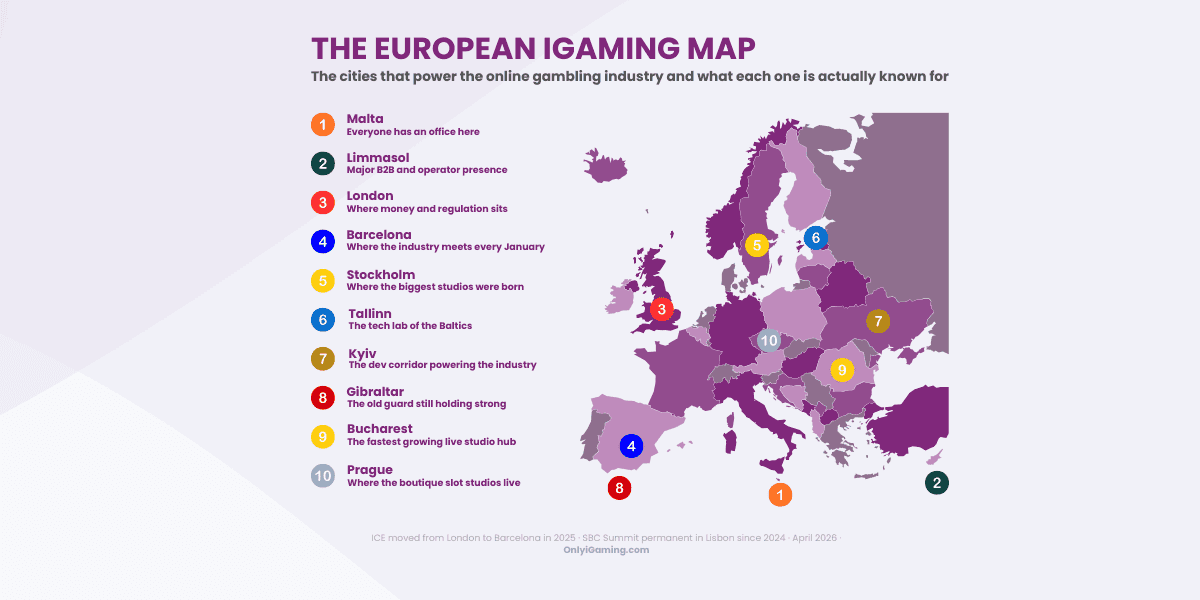
We mapped 10 European hubs and what each one is actually known for. Not where the flags are planted for tax purposes. What each city genuinely contributes to how the industry operates day to day.
1. Malta — Everyone Has an Office Here
Malta is still the iGaming capital of Europe and probably will be for the foreseeable future. The Malta Gaming Authority is one of the most respected licensing bodies in the world. Over 300 licensed operators have substance offices on the island, from the largest publicly listed companies in the sector to boutique startups looking to access regulated European markets.
The reason Malta dominates is structural. The MGA licence opens doors across a wide range of regulated markets. The corporate tax environment is favourable. The island has developed an entire ecosystem of lawyers, accountants, compliance consultants and iGaming specialists that simply does not exist at the same density anywhere else in Europe.
If your iGaming business does not have a Malta presence in 2026 you are an exception.
2. Limassol — The Eastern Mediterranean Corporate Base
Limassol in Cyprus has become one of the most significant corporate hubs in iGaming over the past five years. Major B2B providers and Eastern European operators have made Limassol their EU headquarters, attracted by a stable regulatory environment, favourable corporate structures and a growing pool of iGaming talent.
Companies like Soft2Bet have established significant operations here. The city offers something Malta cannot always provide — space, lower costs and a slightly less saturated talent market. For operators with a strong Eastern European or CIS customer base, Limassol offers a stable EU jurisdiction that makes commercial and operational sense.
3. London — Where the Money and Regulation Sit
London remains the financial and regulatory capital of UK gambling, which means it remains one of the most important cities in the global industry. The UK Gambling Commission is based here and the UKGC licence is still considered the gold standard for consumer protection and regulatory credibility across the industry.
Flutter Entertainment and Entain — the two largest online gambling operators in the world by many measures — are both listed on the London Stock Exchange. The city is home to the legal, financial and investor relations infrastructure that supports the largest operators in the sector. Even companies headquartered elsewhere maintain significant London presences for investor and regulatory engagement.
The UKGC's ongoing enforcement agenda, significant fine history and ambitious regulatory reform programme mean that what happens in London shapes compliance standards across the entire European industry.
4. Barcelona — Where the Industry Meets Every January
Barcelona became the global centre of the iGaming exhibition calendar in January 2025 when ICE relocated from London to the Fira Gran Via. The move was one of the most significant shifts in the industry event calendar in decades and it has already exceeded expectations.
The 2026 edition of ICE Barcelona attracted a record 62,988 industry professionals from 162 nations, a 5% increase on the already record-breaking 2025 edition. The venue is larger, the atmosphere is different and the international attendance — with 83% of visitors travelling from outside Spain — reflects how the move has broadened the event's global reach.
Barcelona is not yet an operational hub for the industry in the way Malta or London are. But for three days every January it is unambiguously the centre of the iGaming world. Deals get done, partnerships get formed and the direction of the year gets set. That function matters.
5. Stockholm — Where the Biggest Studios Were Born
Stockholm and Sweden more broadly is the Silicon Valley of online slots. Evolution AB, the dominant force in live casino globally, was founded here in 2006 and remains listed on Nasdaq Stockholm. NetEnt, which Evolution acquired in 2020, was also a Swedish company. Play'n GO, one of the most respected slot studios in the industry, is headquartered in Växjö.
The Swedish iGaming ecosystem has produced a disproportionate amount of the intellectual property and technical innovation that defines the modern online casino experience. The country's combination of strong engineering culture, access to capital markets and a regulated domestic gambling market has created conditions that have allowed these companies to grow to global scale.
Sweden also has one of the most advanced online gambling regulatory frameworks in Europe, having re-regulated its market in 2019. The experience of operating in the Swedish regulated market has shaped how several of its major studios approach responsible gambling and product design globally.
6. Tallinn — The Tech Lab of the Baltics
Tallinn has established itself as one of the most important technology hubs in European iGaming. Estonia's digital infrastructure, educated workforce and relatively low operational costs have made it attractive for development operations.
Evolution's largest live dealer studio is in Riga in Latvia, but Tallinn and the wider Baltic region have become associated with high-end development talent and a willingness to experiment with emerging technologies. The city has become a base for crypto gaming startups and blockchain-adjacent gambling projects that are looking for a stable EU jurisdiction with a progressive attitude to technology.
For operators and studios looking to build serious development capacity without the cost base of London or Stockholm, Tallinn offers a compelling proposition.
7. Kyiv — The Dev Corridor Powering the Industry
Ukraine has been one of the most important sources of iGaming development talent in Europe for over a decade. Kyiv in particular has a dense concentration of slot studios, game development teams and technology providers that punch well above the country's profile in the mainstream industry conversation.
The ongoing conflict has reshaped but not eliminated Kyiv's role in the sector. Many Ukrainian developers relocated to Warsaw and other Polish cities following 2022, which is why this hub is increasingly referred to as the Kyiv and Warsaw corridor. Poland has become a major safety net for Ukrainian iGaming talent, with Warsaw growing rapidly as an outsourced engineering base for Western European operators and studios.
Together the Kyiv and Warsaw corridor is estimated to contribute approximately 40% of the technical infrastructure supporting the European iGaming industry. That is a number that deserves far more attention than it receives in the mainstream industry conversation.
8. Gibraltar — The Old Guard Still Holding Strong
Gibraltar was one of the first jurisdictions to licence online gambling operators and it remains a significant hub for the sector despite the changes that Brexit brought to its relationship with EU markets. Bet365 and Lottoland both operate from Gibraltar and the territory's combination of low tax rates and established regulatory framework continues to attract operators focused on the UK and select international markets.
The Gibraltar Gambling Commissioner has maintained a reputation for pragmatic and commercially aware regulation. The territory is smaller and more selective than Malta in its approach to licensing, which some operators see as a feature rather than a limitation.
Post-Brexit complexity has added administrative burden for Gibraltar-based operators seeking to serve EU customers, which has pushed some businesses to establish additional bases in Malta or elsewhere. But for UK-focused operations Gibraltar remains a viable and established choice.
9. Bucharest — The Fastest Growing Live Studio Hub
Bucharest has emerged as one of the fastest growing cities in European iGaming over the past three years, driven almost entirely by the expansion of live dealer studio operations. The combination of lower labour costs than Western European cities, a large pool of multilingual talent and improving digital infrastructure has made it attractive for operators and studios looking to scale their live casino capacity.
Several major operators have opened or significantly expanded live dealer studios in Bucharest during this period. The city is increasingly seen as the go-to location for operators who need to build live casino capacity quickly and cost-effectively without the constraints of Malta or the Baltic states.
Romania also has a well-established online gambling regulatory framework, which simplifies local licensing for operators who want to serve the domestic market alongside their international operations.
10. Prague — Where the Boutique Slot Studios Live
Prague and the Czech Republic more broadly have developed a quiet reputation as a hub for boutique slot studio development. The city is home to a high concentration of small and mid-sized game development teams focused on RNG slots, mathematics and technical innovation.
These studios are rarely the ones whose names appear on the front pages of industry publications. But they are often the ones behind the mathematical engines, bonus mechanics and game frameworks that larger studios and operators depend on. Prague's combination of strong technical universities, a European creative culture and lower costs than Western European cities has made it a natural home for this kind of specialised development work.
What the Map Tells Us
Two things stand out when you look at this map as a whole.
The first is the shift in the exhibition calendar. ICE in Barcelona every January and SBC Summit in Lisbon every September now anchor the industry's two most important gathering moments in two different cities on the Atlantic and Mediterranean coasts. The centre of gravity for the industry's physical meeting points has moved decisively away from London over the past two years.
The second is the underappreciated importance of Central and Eastern Europe. Kyiv, Warsaw, Bucharest, Prague and Tallinn together provide a substantial portion of the technical and operational infrastructure that makes the European iGaming industry function. None of these cities feature prominently in the mainstream industry conversation but all of them would be missed if they disappeared.
The iGaming industry is more geographically distributed and more functionally specialised than the conversation around it suggests.
A Note on the Data
City descriptions reflect the primary industry function of each hub as of April 2026 based on public information, industry reports and press coverage. ICE Barcelona attendance figures are sourced from official Clarion Gaming announcements. SBC Summit Lisbon confirmed as permanent home from 2024 onwards based on official SBC Events announcements. CEE infrastructure contribution is an industry estimate widely cited in sector publications.
Last updated: April 2026